Species profile

American dog tick

Dermacentor variabilis
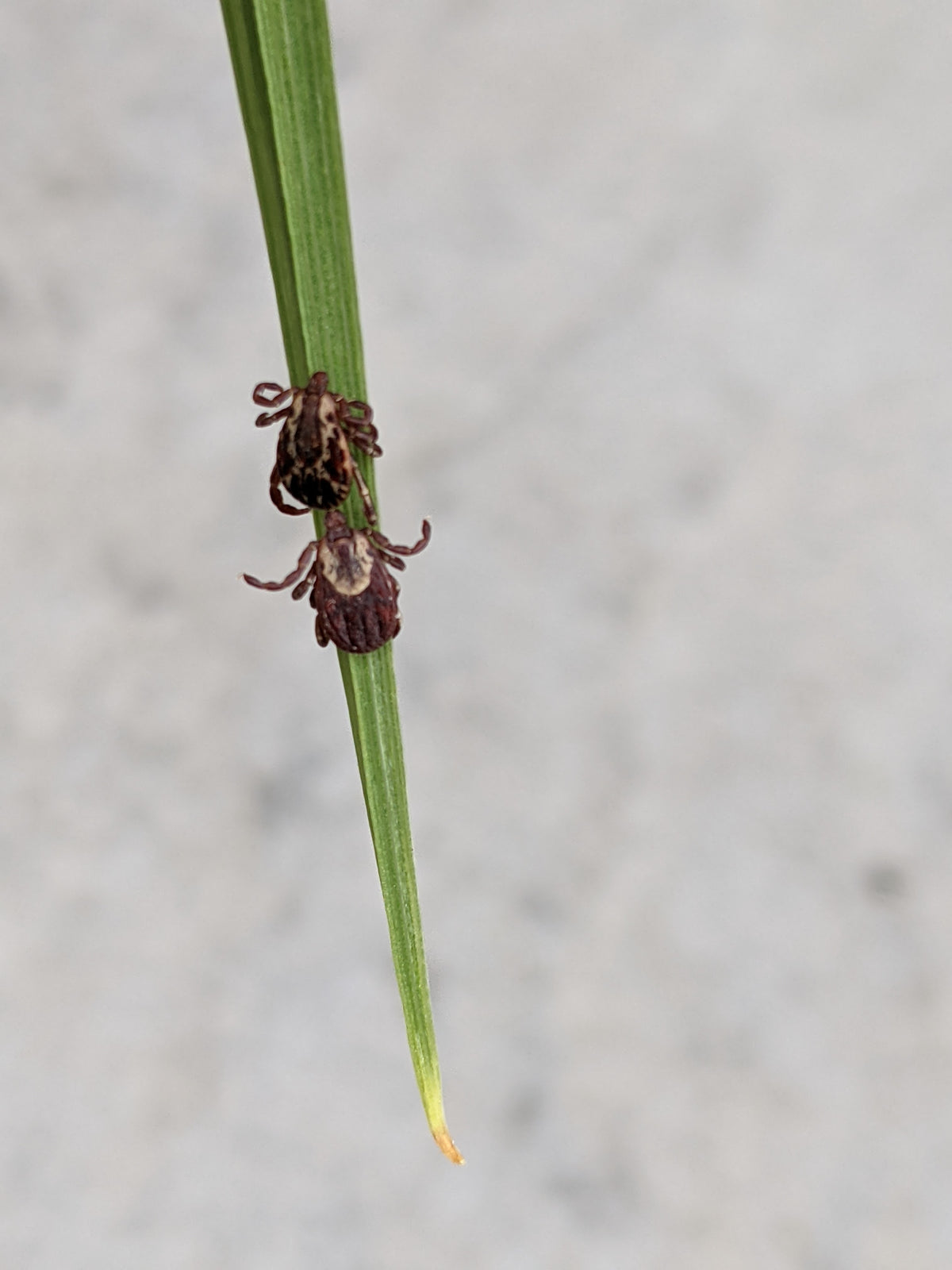
A widespread North American hard tick. Adults commonly bite dogs and humans, while larvae and nymphs feed mainly on small mammals.

Adult male and female Dermacentor variabilis American dog ticks on a blade of grass
mixed · Adult · unfed

Image credit:U.S. Fish and Wildlife Service — Midwest Region Licence terms — Opens in a new window.Source — Opens in a new window.
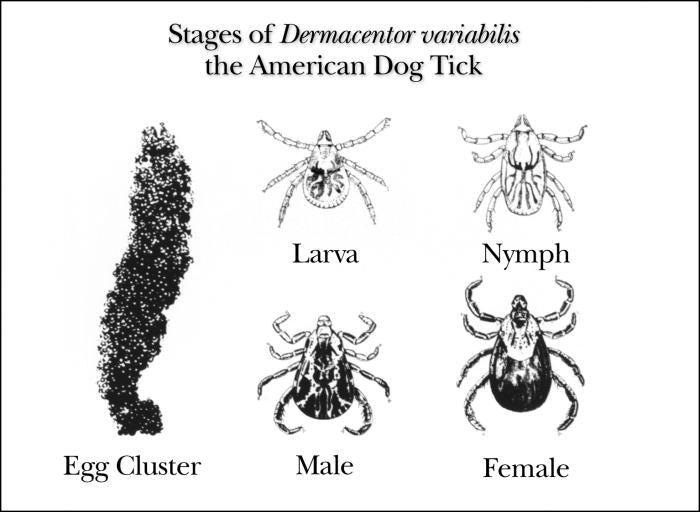
CDC scientific illustration showing Dermacentor variabilis American dog tick development from eggs to adults
not_stated · multiple

Image credit:Centers for Disease Control and Prevention / CDC Licence terms — Opens in a new window.Source — Opens in a new window.
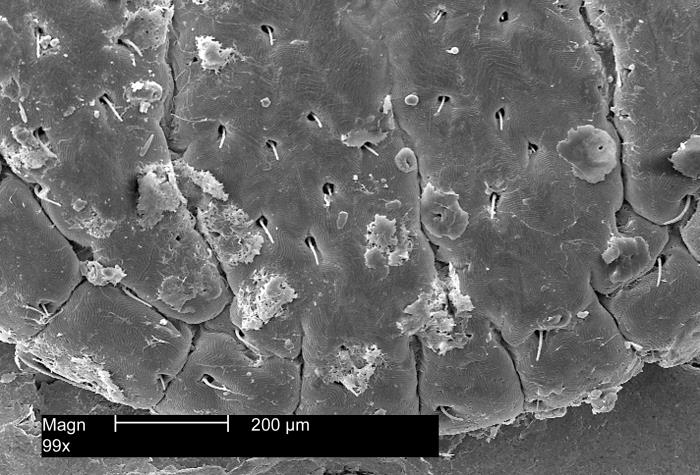
Scanning electron micrograph of the dorsal scutum of Dermacentor variabilis at 99 times magnification
not_stated · Adult · not_stated

Image credit:Janice Haney Carr / CDC Licence terms — Opens in a new window.Source — Opens in a new window.

Also known as: Wood tick

Image gallery

Quick facts

Family: Ixodidae. Genus: Dermacentor. Hard tick. Taxonomic authority: (Say, 1821). Life stages: egg, larva, nymph and adult.

Identification

Adults have short mouthparts, eyes and festoons, with pale ornamentation on the dorsal shield. Females have a pale patterned scutum at the front; males have ornamentation across most of the dorsum.

Short mouthparts, rectangular basis capituli, eyes and festoons. Adult dorsal ornamentation is cream or pale against brown. Immatures are much less conspicuous and require expert keys.

Can be confused with Dermacentor andersoni and other ornate Dermacentor. Range overlap and visual similarity mean photographs may be insufficient for confirmation.

Photographs alone cannot always confirm this species. Geographic location, host and colour are supporting context, not conclusive identification; expert morphological examination may be required.

Sex and appearance differences

Adult females have a smaller ornate scutum over the anterior body; adult males have an ornate scutum covering nearly the whole dorsum. The approved image shows both adult sexes.

Life cycle

Three-host life cycle. Larvae and nymphs feed mainly on small rodents; adult ticks prefer dogs and other medium or large mammals and also bite humans.

Life stages

  • Egg
  • Larva
  • Nymph
  • Adult

Seasonal activity

Adult Dermacentor activity is generally from spring through autumn, with maximum activity often in late spring to early summer; regional timing varies.

Hosts

  • Humans (Homo sapiens)
  • Dogs (Canis lupus familiaris)
  • Small mammals
  • Large mammals

Habitats

  • Woodland edges and trails
  • Grassland and shrubland

Distribution

Widely distributed in the contiguous United States, with reported records across many states. CDC research distinguishes collection records from modelled suitable range and notes incomplete county-level surveillance.

Presence, established populations, habitat suitability and disease risk are distinct evidence categories.

Countries and regions

  • United States — reported_widespread_with_established_areas

    Widely distributed in the contiguous United States, with reported records across many states. CDC research distinguishes collection records from modelled suitable range and notes incomplete county-level surveillance.

  • Colorado — present

    Colorado State University Extension records the American dog tick in Colorado, while noting it is uncommon and often associated with pet movement.

  • Connecticut — present

    Connecticut DPH identifies the American dog tick among Connecticut ticks of public-health relevance.

  • Delaware — present

    Delaware DNREC lists the American dog tick among the five species commonly found in Delaware.

  • Florida — present

    University of Florida IFAS Extension lists the American dog tick among five hard ticks people are most likely to encounter in Florida.

  • Georgia — present

    Georgia DPH surveillance records collected American dog ticks in Georgia.

  • Illinois — present

    Illinois DPH lists the American dog tick among the ticks people are likely to encounter in Illinois.

  • Indiana — present

    Indiana Department of Health identifies the American dog tick among tick species of public-health relevance in Indiana.

  • Iowa — present

    Iowa State University Extension identifies the American dog tick among the most common ticks encountered in Iowa.

  • Kansas — present

    Kansas Department of Health and Environment identifies the American dog tick as a medically important species commonly encountered outdoors in Kansas.

  • Kentucky — present

    Kentucky Fish and Wildlife identifies the American dog tick as one of the most common tick species in Kentucky.

  • Louisiana — present

    LSU AgCenter identifies the American dog tick as one of five hard-tick species of public-health concern in Louisiana.

  • Maine — present

    Maine CDC identifies the American dog tick among the most common ticks seen in Maine.

  • Maryland — present

    Maryland Department of Health identifies the American dog tick among the most common ticks in Maryland.

  • Massachusetts — present

    Massachusetts DPH states that dog ticks are found throughout Massachusetts.

  • Michigan — present

    Michigan DHHS identifies the American dog tick as widespread throughout Michigan forests and grassy areas.

  • Minnesota — present

    Minnesota Department of Health identifies the American dog tick among the types people may encounter in Minnesota.

  • Mississippi — present

    Mississippi State University Extension lists the American dog tick among five significant pest ticks occurring in Mississippi.

  • Missouri — present

    University of Missouri Extension lists the American dog tick among common ticks in Missouri.

  • Montana — present

    Montana State University Extension identifies the American dog tick as frequently found on companion animals in Montana.

  • Nebraska — present

    Nebraska DHHS includes the American dog tick among medically important ticks monitored in Nebraska.

  • New Hampshire — present

    The New Hampshire government source identifies the American dog tick as the most frequently encountered tick in New Hampshire.

  • New York — present

    New York State Department of Health identifies the American dog tick among tick species that can transmit disease in New York.

  • North Carolina — present

    North Carolina DHHS lists the American dog tick among important tick vectors in North Carolina.

  • North Dakota — present

    North Dakota State University Extension records the American dog tick in its North Dakota crop and pest report.

  • Ohio — present

    The Ohio state-commissioned study observed American dog ticks in Ohio.

  • Pennsylvania — present

    Pennsylvania DEP frequently collects American dog ticks during statewide surveillance.

  • Rhode Island — present

    Rhode Island DEM records the American dog tick among ticks of public-health relevance in Rhode Island.

  • South Carolina — present

    South Carolina DPH lists the American dog tick among six species often encountered in South Carolina.

  • South Dakota — present

    South Dakota State University Extension identifies the American dog tick among common ticks in South Dakota.

  • Tennessee — present

    Tennessee Department of Health lists the American dog tick among six key species living in Tennessee.

  • Vermont — present

    Vermont Department of Health records the American dog tick throughout Vermont.

  • Virginia — present

    Virginia Department of Health records the American dog tick throughout Virginia.

  • West Virginia — present

    West Virginia OEPS includes the American dog tick in its state tick species distribution data.

  • Wisconsin — present

    Wisconsin DHS lists the American dog tick among three tick types that can spread disease to people in Wisconsin.

  • Wyoming — present

    Wyoming's 2025 Tick Blitz identified American dog ticks in statewide collections.

  • Canada — present

    The Public Health Agency of Canada identifies the American dog tick among tick species found in Canada.

  • Alberta — present

    Government of Alberta surveillance guidance identifies the American dog tick in Alberta.

  • Nova Scotia — present

    Government of Nova Scotia tick-safety guidance identifies the dog tick among ticks encountered in the province.

  • Saskatchewan — present

    Government of Saskatchewan lists the American dog tick among ticks found in Saskatchewan.

Medical and veterinary relevance

A confirmed U.S. vector of Rickettsia rickettsii and Francisella tularensis and a species associated with tick paralysis. The presence of the tick or detection of an organism does not establish that transmission occurred in a particular bite.

Adults commonly feed on dogs and may affect other medium and large mammals. Veterinary relevance includes infestation and pathogen exposure.

Pathogens and diseases

  • Rocky Mountain spotted fever — disease

    A rickettsial disease transmitted in the United States mainly by American dog ticks, Rocky Mountain wood ticks and, in certain areas, brown dog ticks.

  • Tularemia — disease

    A disease caused by Francisella tularensis; several tick species can act as vectors in defined regions.

  • Tick paralysis — condition

    A toxin-mediated condition associated with feeding by certain tick species; it is not an infectious disease.

Detection of a pathogen in a tick does not by itself establish that the species is a confirmed vector.

Vector and pathogen evidence

CDC identifies the American dog tick as a principal U.S. vector of Rickettsia rickettsii and a vector of Francisella tularensis. Tick paralysis is toxin-mediated rather than infectious.

Medical importance

One of the most frequently recorded U.S. ticks on humans. Adult bites are the main human exposure stage.

Veterinary importance

High relevance to dogs within its range; adults also feed on other large mammals.

Prevention and removal guidance

Prevent tick bites by using current public-health guidance, walking in the centre of trails where practical, using appropriate repellents, treating clothing or gear where suitable, and performing thorough tick checks after exposure.

Remove an attached tick promptly with fine-tipped tweezers or a purpose-designed tick-removal tool. Grasp close to the skin and pull upward steadily without twisting or crushing the tick. Seek professional medical or veterinary advice when symptoms or concerns arise.

Important identification and health information

Educational information and limitations

Photographs and visible features may be insufficient for definitive identification.

This educational information is not a diagnosis or a substitute for medical or veterinary advice.

This educational information does not replace examination or advice from a qualified veterinary professional.

Presence, established populations, habitat suitability and disease risk are distinct evidence categories.