Species profile

Nuttalliella tick

Nuttalliella namaqua
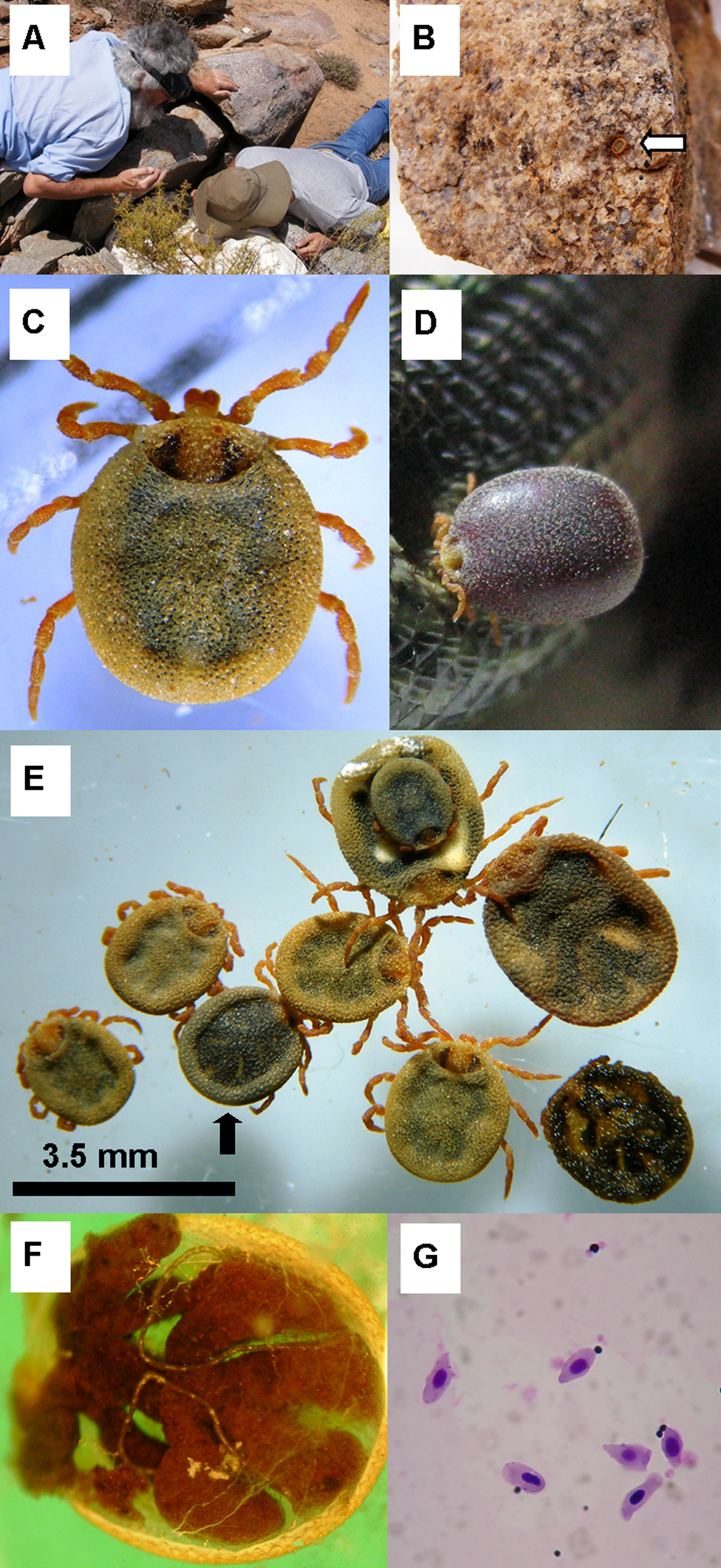
The sole living species of Nuttalliellidae, an uncommon African tick lineage with a distinctive mixture of hard-tick, soft-tick and unique anatomical features.

Nuttalliella namaqua, female, adult — verified scientific reference image
female · Adult · engorged_or_included_in_composite

Image credit:Ben J. Mans, Daniel de Klerk, Ronel Pienaar and Abdalla A. Latif; source PLOS ONE 6(8):e23675; CC BY 2.5 Licence terms — Åpner i et nytt vindu.Source — Åpner i et nytt vindu.
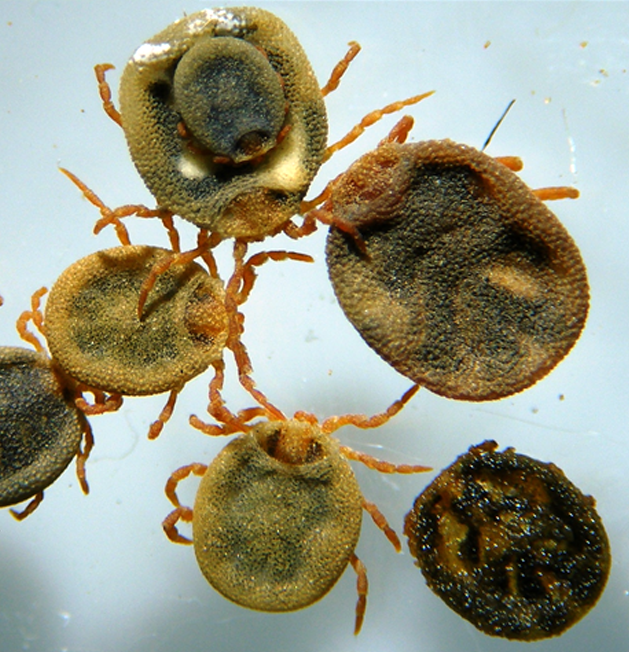
Nuttalliella namaqua, not reliably assigned from cropped panel, adult — verified scientific reference image
not reliably assigned from cropped panel · Adult · not_stated

Image credit:Original authors and derivative contributor Stemonitis; source PLOS ONE; CC BY 2.5 Licence terms — Åpner i et nytt vindu.Source — Åpner i et nytt vindu.

Image gallery

Quick facts

Sole extant species of Nuttalliellidae.

Recorded from Botswana, Mozambique, Namibia, South Africa and Tanzania.

Adults and nymphs have a pseudoscutum and conspicuous ball-and-socket leg joints; larvae possess a true scutum.

Published host evidence includes reptiles and mammals.

No pathogen-transmission association was identified by the reviewed scientific literature.

Identification

A specialist-confirmation species with a partly sclerotised pseudoscutum, apically positioned mouthparts and distinctive ball-and-socket leg joints in adults and nymphs. Its anatomy combines traits associated with hard and soft ticks while also containing features unique to Nuttalliellidae.

Adults and nymphs show a partly sclerotised pseudoscutum, leathery convoluted integument, apically positioned capitulum and conspicuous ball-and-socket articulation of the leg segments. The larva has a true scutum, a dentate anal plate and visible leg pores. These characters require examination against an authoritative morphological description.

Unlike a conventional hard tick, adults do not have a true rigid scutum; unlike typical soft ticks, the capitulum is positioned apically. The pseudoscutum and unusually deep ball-and-socket leg joints are especially important distinguishing features.

Photographs, host and location alone may be insufficient for reliable species confirmation. Nuttalliella namaqua is rare and morphologically exceptional; confirmation should use the published stage-specific descriptions or an experienced tick taxonomist.

Sex and appearance differences

Females, males, nymphs and larvae have been described. Males are very rarely collected. Adults and nymphs possess a pseudoscutum; the larva possesses a true scutum and additional distinctive structures described in the taxonomic literature.

Life cycle

Egg, larval, nymphal and adult stages are recognised, but the complete natural life cycle remains incompletely established. Experimental work showed successful feeding on lizards; engorgement may be rapid compared with many hard ticks.

Life stages

  • Egg
  • Larva
  • Nymph
  • Adult

Seasonal activity

No sufficiently supported general seasonal pattern was accepted from the reviewed sources. Collection records should not be interpreted as a complete activity calendar.

Distribution

Confirmed collection records are reported from Botswana, Mozambique, Namibia, South Africa and Tanzania. Most southern African records are associated with arid or semi-arid localities. These records demonstrate documented presence at collection sites; they do not establish uniform national distribution, abundance or disease risk.

Presence, established populations, habitat suitability and disease risk are distinct evidence categories.

Medical and veterinary relevance

The reviewed literature does not link Nuttalliella namaqua to transmission of a human pathogen. This is not proof that every possible health association has been excluded.

Published studies document feeding on reptiles and mammals, but the reviewed evidence does not establish this species as a vector of a veterinary pathogen.

Vector and pathogen evidence

No confirmed vector role was identified in the reviewed sources. Pathogen transmission must not be inferred from blood-feeding behaviour or host records.

Medical importance

Current reviewed evidence does not establish this species as a human disease vector. Any attached tick should still be removed safely, and medical advice sought for concerning symptoms after a bite.

Veterinary importance

Natural and experimental host evidence includes lizards and mammals, but the reviewed studies do not establish veterinary pathogen transmission by this species.

Prevention and removal guidance

Avoid handling ticks with bare fingers. In rocky or arid habitats, use suitable protective clothing and inspect people and animals after potential exposure.

Remove an attached tick promptly with a suitable fine-tipped tool, gripping close to the skin and pulling steadily without twisting or crushing. Seek professional advice when removal is difficult or symptoms develop.

Important identification and health information

Educational information and limitations

Photographs and visible features may be insufficient for definitive identification.

This educational information is not a diagnosis or a substitute for medical or veterinary advice.

This educational information does not replace examination or advice from a qualified veterinary professional.

Presence, established populations, habitat suitability and disease risk are distinct evidence categories.