Profil de l'espèce

Brown dog tick

Rhipicephalus sanguineus
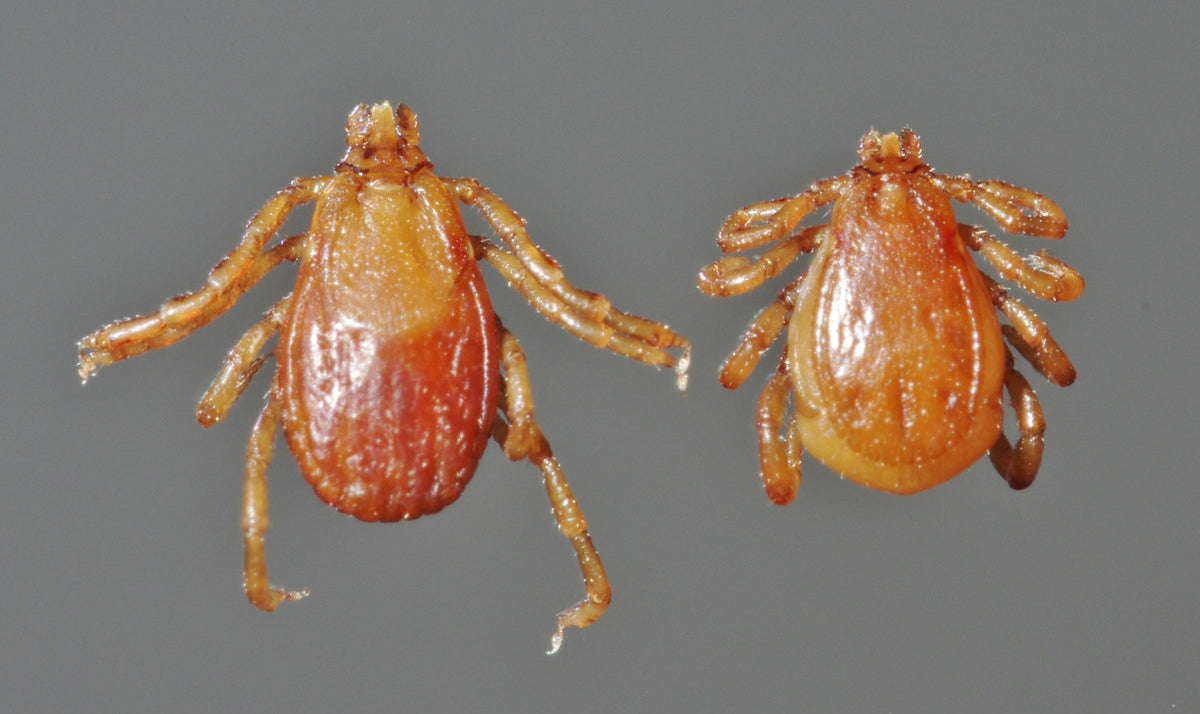
A globally distributed, dog-associated hard tick able to complete its life cycle in buildings and kennels. UK records are linked to importation; UKHSA reports no current evidence of establishment outdoors or as a resident UK population.

Adult female and male Rhipicephalus sanguineus brown dog ticks in dorsal view
Adult female and male, dorsal view

Crédit image:Daktaridudu / Wikimedia Commons Conditions de licence — S’ouvre dans une nouvelle fenêtre.Source — S’ouvre dans une nouvelle fenêtre.

Galerie d'images

Faits rapides

Family: Ixodidae. Genus: Rhipicephalus. Tick type: hard tick.

Taxonomic authority: (Latreille, 1806).

Recorded life-cycle stages: egg, larva, nymph, adult.

Identification

Laterally produced angular basis capituli.

Eyes and festoons present.

Scutum lacks ornamentation.

Mouthparts relatively short compared with the basis capituli.

Coxa I has large paired internal and external spurs.

Rhipicephalus sanguineus is a species complex in some literature; expert morphological and sometimes molecular review may be necessary.

Laterally produced angular basis capituli.

Eyes and festoons present.

Scutum lacks ornamentation.

Mouthparts relatively short compared with the basis capituli.

Coxa I has large paired internal and external spurs.

Rhipicephalus sanguineus is a species complex in some literature; expert morphological and sometimes molecular review may be necessary.

Photographs alone cannot always confirm a tick species.

Cycle de vie

three_host_monotropic_preference

Dogs are the preferred host at each parasitic stage, although other domestic and wild mammals may be used.

Highly endophilic and capable of maintaining populations in heated domestic or kennel environments.

Répartition

UKHSA states that UK records have been linked to imported dogs or goods and that there is currently no evidence supporting UK establishment.

La présence, les populations établies, la qualité de l'habitat et le risque de maladie sont des catégories de preuves distinctes.

Pays et régions

  • Europe — present

    ECDC publishes confirmed European distribution data for the Rhipicephalus sanguineus group.

  • Texas — established_widespread

    In a Texas study of 1,625 ticks removed from people and submitted during 2014–2021, Rhipicephalus sanguineus represented 3.8% of submitted ticks. Submission frequency reflects human–tick interactions in the study dataset, not complete statewide abundance.

  • Colorado — present

    Colorado State University Extension includes the brown dog tick among ticks found in Colorado.

  • Florida — present

    University of Florida IFAS Extension lists the brown dog tick among five hard ticks people are most likely to encounter in Florida.

  • Georgia — present

    Georgia DPH surveillance records collected brown dog ticks in Georgia.

  • Hawaii — present

    Hawaii Department of Health identifies the brown dog tick as one of only two tick species recorded in Hawaii.

  • Illinois — present

    Illinois DPH lists the brown dog tick among the ticks people are likely to encounter in Illinois.

  • Indiana — present

    Indiana Department of Health identifies the brown dog tick among tick species of public-health relevance in Indiana.

  • Louisiana — present

    LSU AgCenter identifies the brown dog tick as one of five hard-tick species of public-health concern in Louisiana.

  • Michigan — present

    Michigan DHHS records the brown dog tick as occasionally found in Michigan.

  • Mississippi — present

    Mississippi State University Extension lists the brown dog tick among five significant pest ticks occurring in Mississippi.

  • Missouri — present

    University of Missouri Extension lists the brown dog tick among common ticks in Missouri.

  • Montana — present

    Montana State University Extension records the brown dog tick as less frequently found in Montana.

  • New Mexico — present

    New Mexico Department of Health identifies the brown dog tick as the most common tick in New Mexico.

  • Oregon — present

    Oregon Health Authority records the brown dog tick throughout Oregon.

  • South Carolina — present

    South Carolina DPH lists the brown dog tick among six species often encountered in South Carolina.

  • Tennessee — present

    Tennessee Department of Health lists the brown dog tick among six key species living in Tennessee.

  • Utah — present

    Utah State University Extension records the brown dog tick as occasionally brought into Utah homes.

  • Vermont — present

    Vermont Department of Health records the brown dog tick throughout Vermont.

Pertinence médicale et vétérinaire

Human-biting evidence status: occasional human biter.

Rickettsia rickettsii (Rocky Mountain spotted fever): confirmed vector in specific regions of southwestern us and mexico. Scope: not a uk transmission claim.

Rickettsia conorii (Mediterranean spotted fever): vector association reported by cdc.

Ehrlichia canis (Canine monocytic ehrlichiosis): veterinary vector association reported.

undefined: association reported; taxonomy and regional vector competence require pathogen-level review.

Veterinary relevance status: high for dogs.

Preuves vectorielles et pathogènes

Rickettsia rickettsii

Rocky Mountain spotted fever

confirmed_vector_in_specific_regions_of_southwestern_us_and_mexico

not a uk transmission claim

Rickettsia conorii

Mediterranean spotted fever

vector_association_reported_by_cdc

Ehrlichia canis

Canine monocytic ehrlichiosis

veterinary_vector_association_reported

Babesia species affecting dogs

association_reported; taxonomy and regional vector competence require pathogen-level review

Importance médicale

occasional_human_biter

Rickettsia rickettsii

Rocky Mountain spotted fever

confirmed_vector_in_specific_regions_of_southwestern_us_and_mexico

not a uk transmission claim

Rickettsia conorii

Mediterranean spotted fever

vector_association_reported_by_cdc

Ehrlichia canis

Canine monocytic ehrlichiosis

veterinary_vector_association_reported

Babesia species affecting dogs

association_reported; taxonomy and regional vector competence require pathogen-level review

Importance vétérinaire

high_for_dogs

Rickettsia rickettsii

Rocky Mountain spotted fever

confirmed_vector_in_specific_regions_of_southwestern_us_and_mexico

not a uk transmission claim

Rickettsia conorii

Mediterranean spotted fever

vector_association_reported_by_cdc

Ehrlichia canis

Canine monocytic ehrlichiosis

veterinary_vector_association_reported

Babesia species affecting dogs

association_reported; taxonomy and regional vector competence require pathogen-level review

Informations importantes d'identification et de santé

Informations pédagogiques et limitations

Les photographies et les caractéristiques visibles peuvent ne pas suffire pour une identification définitive.

Ces informations pédagogiques ne constituent pas un diagnostic et ne remplacent en aucun cas un avis médical ou vétérinaire.

Ces informations pédagogiques ne remplacent en aucun cas un examen ou les conseils d'un professionnel vétérinaire qualifié.

La présence, les populations établies, la qualité de l'habitat et le risque de maladie sont des catégories de preuves distinctes.