Profil de l'espèce

Eurasian sheep tick

Rhipicephalus bursa
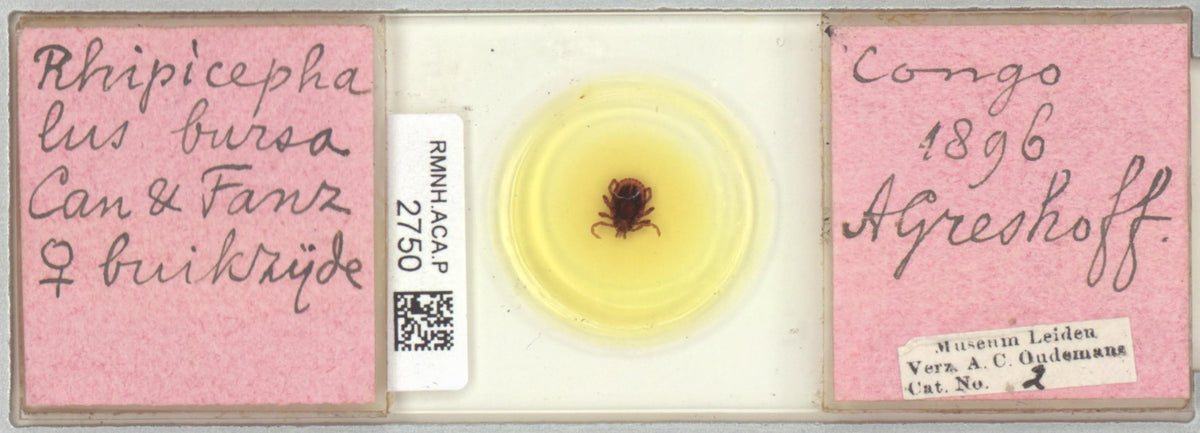
A two-host hard tick of livestock and wildlife in Mediterranean and adjoining regions, particularly associated with sheep and goats.

Eurasian sheep tick (Rhipicephalus bursa) verified reference image
Verified species reference image.

Crédit image:Naturalis Biodiversity Center; CC0 1.0; source Wikimedia Commons Conditions de licence — S’ouvre dans une nouvelle fenêtre.Source — S’ouvre dans une nouvelle fenêtre.

Galerie d'images

Faits rapides

A two-host hard tick of livestock and wildlife in Mediterranean and adjoining regions, particularly associated with sheep and goats.

Adults commonly parasitise sheep, goats and cattle; immature stages use smaller mammals and other hosts.

Established across parts of southern Europe, North Africa and western Asia; ECDC/EFSA maps distinguish reported and established occurrence.

Identification

Species-level confirmation should use appropriate morphological keys and, where necessary, expert examination. Photographs, host and location alone may be insufficient.

Identification requires the complete combination of family, genus and species-level morphological characters.

Use authoritative comparative keys; do not rely on colour, size, host or geography as a single diagnostic feature.

Photographs alone cannot always confirm this species.

Différences sexuelles et d'apparence

Adult males and females differ in dorsal shield coverage and feeding-related expansion; confirm stage and sex using an appropriate key.

Cycle de vie

Egg, larva, nymph and adult stages are present; host-use pattern is species-specific.

Étapes de la vie

  • Egg
  • Larva
  • Nymph
  • Adult

Activité saisonnière

Seasonal activity varies geographically and should be interpreted from local surveillance.

Répartition

Established across parts of southern Europe, North Africa and western Asia; ECDC/EFSA maps distinguish reported and established occurrence.

La présence, les populations établies, la qualité de l'habitat et le risque de maladie sont des catégories de preuves distinctes.

Pertinence médicale et vétérinaire

Veterinary importance includes documented associations with piroplasms. Disease-agent detection, biological transmission and regional disease risk must be distinguished.

Adults commonly parasitise sheep, goats and cattle; immature stages use smaller mammals and other hosts.

Preuves vectorielles et pathogènes

Veterinary importance includes documented associations with piroplasms. Disease-agent detection, biological transmission and regional disease risk must be distinguished.

Importance médicale

Human-health relevance is stated only where governed evidence supports human biting or transmission; otherwise no human-vector claim is made.

Importance vétérinaire

Veterinary relevance is based on documented host use, livestock exposure and separately cited transmission evidence.

Conseils pour la prévention et l'élimination

Use habitat-appropriate tick avoidance, animal inspection and veterinary-led control.

Remove attached ticks promptly using evidence-based guidance and seek medical or veterinary advice when indicated.

Informations importantes d'identification et de santé

Informations pédagogiques et limitations

Les photographies et les caractéristiques visibles peuvent ne pas suffire pour une identification définitive.

Ces informations pédagogiques ne constituent pas un diagnostic et ne remplacent en aucun cas un avis médical ou vétérinaire.

Ces informations pédagogiques ne remplacent en aucun cas un examen ou les conseils d'un professionnel vétérinaire qualifié.

La présence, les populations établies, la qualité de l'habitat et le risque de maladie sont des catégories de preuves distinctes.