Profil de l'espèce

Hedgehog tick

Ixodes hexagonus
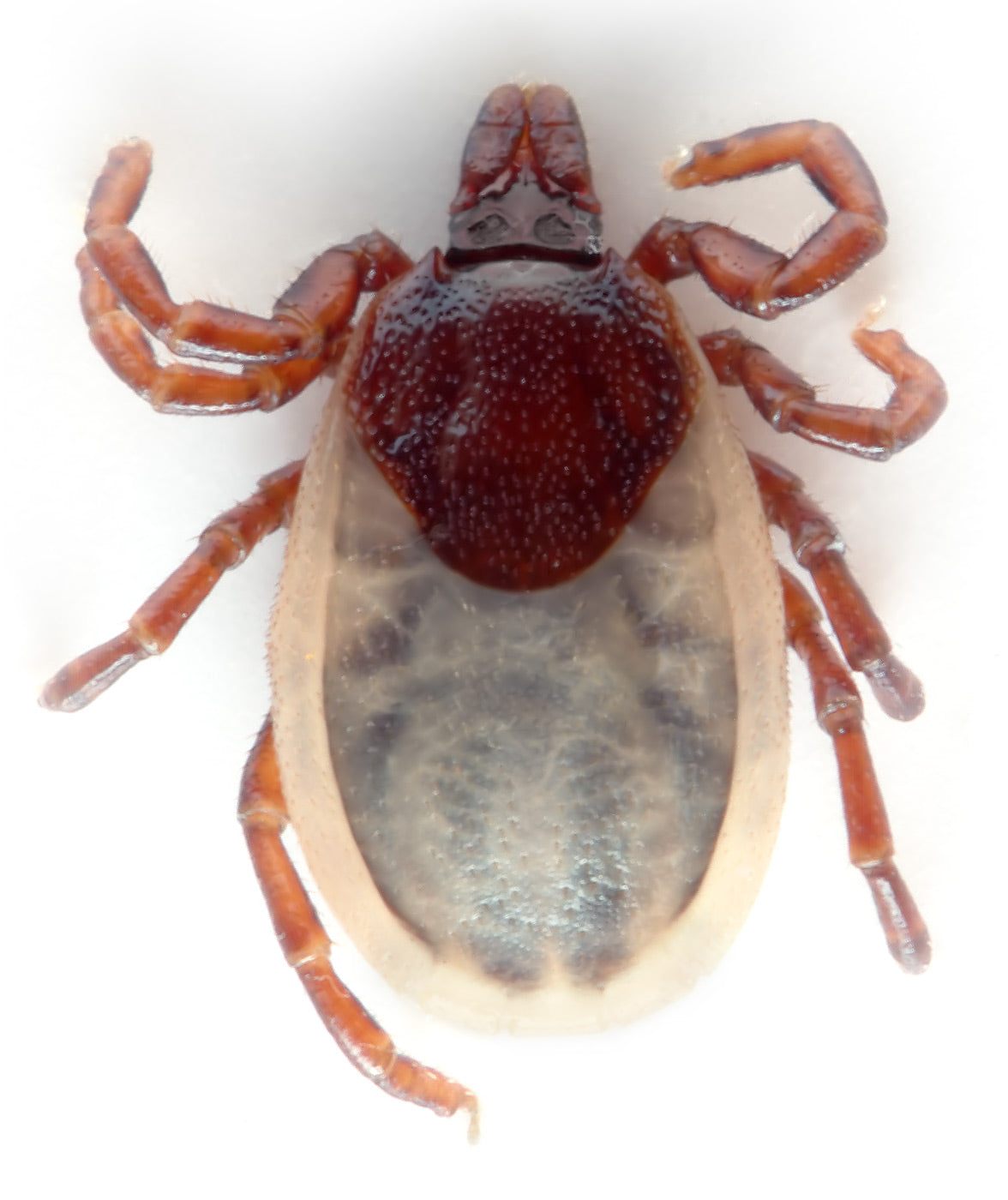
A nest-associated European hard tick primarily linked with hedgehogs and other den-dwelling mammals. It commonly infests cats and dogs in the UK and can bite humans.

Macro dorsal photograph of a living adult female Ixodes hexagonus hedgehog tick
Adult female, dorsal macro view

Crédit image:André Karwath / Wikimedia Commons Conditions de licence — S’ouvre dans une nouvelle fenêtre.Source — S’ouvre dans une nouvelle fenêtre.

Galerie d'images

Faits rapides

Family: Ixodidae. Genus: Ixodes. Tick type: hard tick.

Taxonomic authority: Leach, 1815.

Recorded life-cycle stages: egg, larva, nymph, adult.

Identification

Ixodes genus: eyes and festoons absent; anal groove anterior to the anus.

Adult female palps slope inward and tarsus I is stepped.

Adult male has a broad oval body and a median ventral plate almost as wide as long.

Microscopic characters may be required; photographs alone cannot always confirm the species.

Ixodes genus: eyes and festoons absent; anal groove anterior to the anus.

Adult female palps slope inward and tarsus I is stepped.

Adult male has a broad oval body and a median ventral plate almost as wide as long.

ESCCAP illustrates a broadly hexagonal female scutum compared with the more rounded scutum of Ixodes ricinus.

Microscopic characters may be required; photographs alone cannot always confirm the species.

Photographs alone cannot always confirm a tick species.

Cycle de vie

three_host_nidicolous

Approximately three years is reported by ESCCAP UK & Ireland.

Parasitic stages usually feed for about 7–8 days on nest-dwelling hosts.

Activité saisonnière

ESCCAP reports activity beginning around February, a spring peak around April–May, a decline in June–July and a second peak from August to October, with possible winter activity in nests.

Seasonality is local and climate-dependent.

Répartition

UKHSA describes the species as ubiquitous on hedgehogs; surveillance records occur across the UK.

La présence, les populations établies, la qualité de l'habitat et le risque de maladie sont des catégories de preuves distinctes.

Pays et régions

  • United Kingdom — present

    Included in the UKHSA tick species profiles for the United Kingdom.

Pertinence médicale et vétérinaire

Human infestations and increasing surveillance incidence of human bites are reported, but it is less important to UK human health than Ixodes ricinus.

Human-biting evidence status: confirmed bites.

undefined: detected or associated; transmission significance unresolved.

Babesia microti: association reported; vector competence not asserted here.

Rickettsia conorii: association reported; vector competence not asserted here.

A common tick of cats and the second most common tick reported on dogs by ESCCAP UK & Ireland.

Veterinary relevance status: high companion animal relevance.

Preuves vectorielles et pathogènes

Borrelia burgdorferi sensu lato

detected_or_associated; transmission significance unresolved

Babesia microti

association_reported; vector competence not asserted here

Rickettsia conorii

association_reported; vector competence not asserted here

Importance médicale

confirmed_bites

Human infestations and increasing surveillance incidence of human bites are reported, but it is less important to UK human health than Ixodes ricinus.

Borrelia burgdorferi sensu lato

detected_or_associated; transmission significance unresolved

Babesia microti

association_reported; vector competence not asserted here

Rickettsia conorii

association_reported; vector competence not asserted here

Importance vétérinaire

high_companion_animal_relevance

A common tick of cats and the second most common tick reported on dogs by ESCCAP UK & Ireland.

Borrelia burgdorferi sensu lato

detected_or_associated; transmission significance unresolved

Babesia microti

association_reported; vector competence not asserted here

Rickettsia conorii

association_reported; vector competence not asserted here

Informations importantes d'identification et de santé

Informations pédagogiques et limitations

Les photographies et les caractéristiques visibles peuvent ne pas suffire pour une identification définitive.

Ces informations pédagogiques ne constituent pas un diagnostic et ne remplacent en aucun cas un avis médical ou vétérinaire.

Ces informations pédagogiques ne remplacent en aucun cas un examen ou les conseils d'un professionnel vétérinaire qualifié.

La présence, les populations établies, la qualité de l'habitat et le risque de maladie sont des catégories de preuves distinctes.