Profil de l'espèce

Asian longhorned tick

Haemaphysalis longicornis
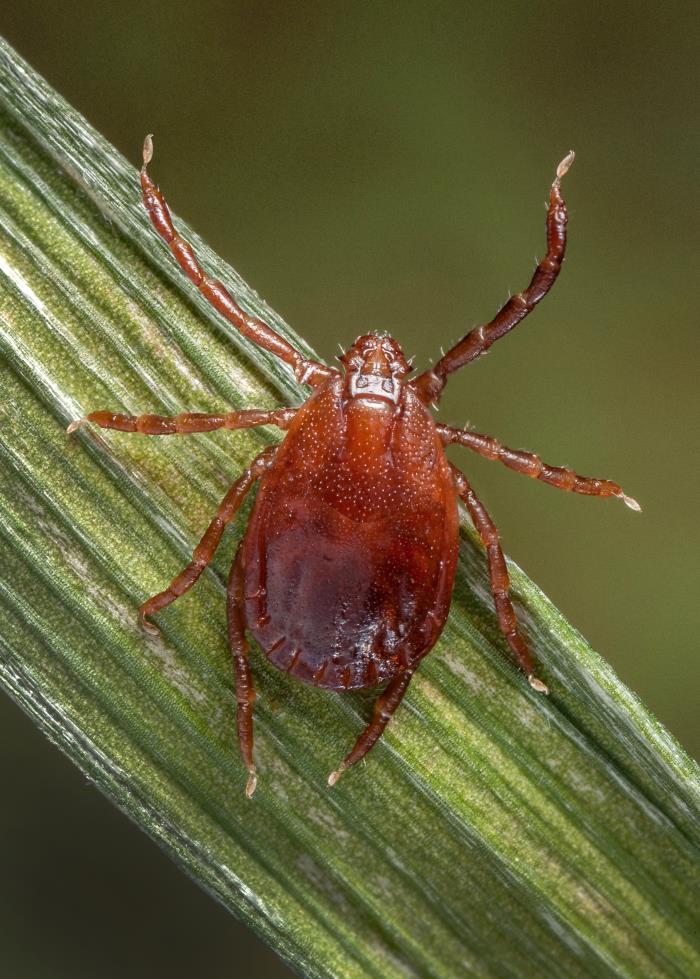
An invasive hard tick established in parts of the eastern United States and a major livestock concern. U.S. populations reproduce parthenogenetically.

Également connu sous le nom de: Bush tick, Cattle tick, Scrub tick

Galerie d'images

Faits rapides

Family: Ixodidae. Genus: Haemaphysalis. Hard tick.

Identification

Unfed stages are small and reddish-tan to dark reddish-brown. Adult females can become grey-green after feeding. Definitive identification requires expert examination.

Photographs and location alone may be insufficient for confirmation; use expert morphological examination when reliable species identification is required.

Photographs alone cannot always confirm this species. Geographic location and host are supporting context, not conclusive identification.

Différences sexuelles et d'apparence

APHIS reports that males are rare in established U.S. parthenogenetic populations. Adult females can reproduce without mating.

Cycle de vie

Three-host hard-tick life cycle with egg, larva, nymph and adult stages.

Étapes de la vie

  • Egg
  • Larva
  • Nymph
  • Adult

Activité saisonnière

APHIS reports general activity from March to November, varying by year and locality.

Hôtes

  • Humans (Homo sapiens)
  • Cattle (Bos taurus)
  • Sheep
  • Goats
  • Horses
  • Dogs (Canis lupus familiaris)
  • Deer
  • Wildlife

Habitats

  • Pasture
  • Grassland and shrubland
  • Woodland edges and trails

Répartition

Introduced and established in multiple eastern U.S. states. Official county records and establishment status should be read from current USDA surveillance.

La présence, les populations établies, la qualité de l'habitat et le risque de maladie sont des catégories de preuves distinctes.

Pays et régions

  • United States — introduced_established

    Introduced and established in multiple eastern U.S. states. Official county records and establishment status should be read from current USDA surveillance.

  • Oceania — present

    New Zealand MPI identifies Haemaphysalis longicornis as the established New Zealand cattle tick.

  • Asia — present

    Peer-reviewed pooled distribution evidence identifies Haemaphysalis longicornis as native to and predominantly distributed in eastern Asia.

  • Delaware — present

    Delaware DNREC lists the Asian longhorned tick among the five species commonly found in Delaware.

  • Indiana — present

    Indiana Department of Health identifies the Asian longhorned tick among tick species of public-health relevance in Indiana.

  • New Jersey — present

    New Jersey DEP records the Asian longhorned tick in multiple New Jersey counties.

  • Ohio — present

    The Ohio state-commissioned study reports the first detection of the Asian longhorned tick in Ohio.

  • Pennsylvania — present

    Pennsylvania DEP frequently collects Asian longhorned ticks during statewide surveillance.

  • South Carolina — present

    South Carolina DPH lists the Asian longhorned tick among six species often encountered in South Carolina.

  • Tennessee — present

    Tennessee Department of Health lists the Asian longhorned tick among six key species and notes it was recently found in eastern Tennessee.

Pertinence médicale et vétérinaire

Bites humans but CDC describes it as less attracted to people than several common native U.S. ticks. Potential and laboratory competence must be separated from confirmed field transmission.

High veterinary importance because heavy infestations can affect livestock and it transmits Theileria orientalis Ikeda.

Pathogènes et maladies

  • Theileria orientalis Ikeda infection — veterinary_disease
  • Heartland virus disease — disease

    CDC identifies the lone star tick as the vector of Heartland virus.

La détection d'un agent pathogène chez une tique n'établit pas en soi que l'espèce est un vecteur confirmé.

Preuves vectorielles et pathogènes

Confirmed vector of Theileria orientalis Ikeda in cattle. Laboratory Heartland virus transmission does not establish its field role in U.S. human disease. U.S. evidence indicates incompetence for Borrelia burgdorferi and Anaplasma phagocytophilum.

Importance médicale

Importance vétérinaire

Conseils pour la prévention et l'élimination

Use current public-health and veterinary guidance, avoid known tick habitats where practical, use suitable repellents or protective clothing, and check people and animals after exposure.

Remove attached ticks promptly using fine-tipped tweezers or an appropriate tick-removal tool. Seek medical or veterinary advice when symptoms or concerns arise.

Informations importantes d'identification et de santé

Informations pédagogiques et limitations

Les photographies et les caractéristiques visibles peuvent ne pas suffire pour une identification définitive.

Ces informations pédagogiques ne constituent pas un diagnostic et ne remplacent en aucun cas un avis médical ou vétérinaire.

Ces informations pédagogiques ne remplacent en aucun cas un examen ou les conseils d'un professionnel vétérinaire qualifié.

La présence, les populations établies, la qualité de l'habitat et le risque de maladie sont des catégories de preuves distinctes.