Profil de l'espèce

Rocky Mountain wood tick

Dermacentor andersoni
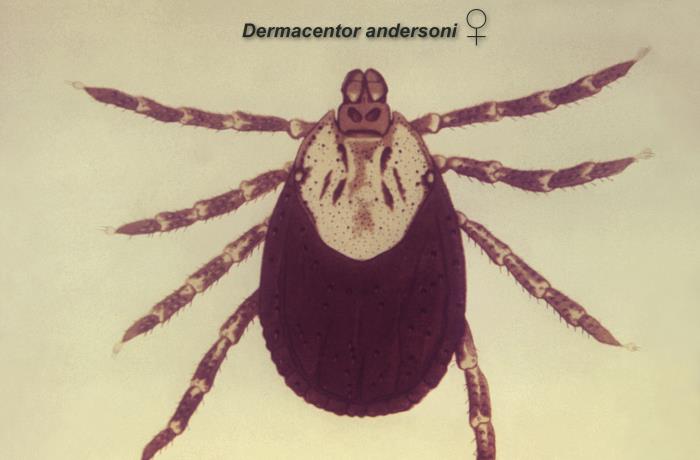
A hard tick of the Rocky Mountain states and southwestern Canada. Adults are the principal stage associated with pathogen transmission to humans.

Également connu sous le nom de: Rocky Mountain tick

Galerie d'images

Faits rapides

Family: Ixodidae. Genus: Dermacentor. Hard tick. Taxonomic authority: Stiles, 1908. Life stages: egg, larva, nymph and adult. CDC reports a two-to-three-year life cycle.

Identification

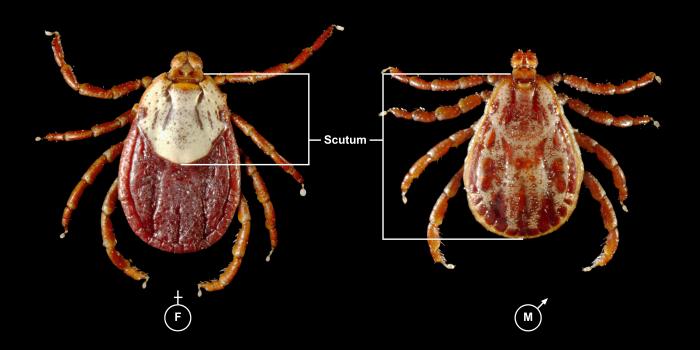
Adults are ornate Dermacentor ticks with short mouthparts, eyes and festoons. Females have a cream-patterned anterior scutum; males show pale mottling across most of the dorsum.

Short mouthparts, eyes, festoons and an ornate dorsal shield. Adult morphology is the most useful field-visible stage, but definitive separation from related Dermacentor may require expert examination.

May be confused with Dermacentor variabilis. Location and altitude are useful context but do not replace morphology.

Photographs alone cannot always confirm this species. Geographic location, host and colour are supporting context, not conclusive identification; expert morphological examination may be required.

Différences sexuelles et d'apparence

Adult females have a relatively small cream-patterned anterior scutum and an expandable posterior body. Adult males have an ornate scutum covering nearly the whole dorsum. The accepted CDC image displays adult female and male together.

Cycle de vie

Three-host life cycle that may require two to three years. Adults feed mainly on large mammals; larvae and nymphs feed largely on small rodents.

Étapes de la vie

  • Egg
  • Larva
  • Nymph
  • Adult

Activité saisonnière

Adult Dermacentor activity is mainly spring through autumn, often highest in late spring and early summer. Local elevation and climate alter timing.

Hôtes

  • Humans (Homo sapiens)
  • Small mammals
  • Large mammals
  • Livestock
  • Dogs (Canis lupus familiaris)

Habitats

  • Rocky Mountain rangeland
  • Grassland and shrubland

Répartition

Occurs in Rocky Mountain states and southwestern Canada, commonly at elevations reported by CDC from approximately 4,000 to 10,500 feet. This is a regional distribution statement, not a prediction of encounter risk at every location.

La présence, les populations établies, la qualité de l'habitat et le risque de maladie sont des catégories de preuves distinctes.

Pays et régions

  • United States — established_regional

    Occurs in Rocky Mountain states and southwestern Canada, commonly at elevations reported by CDC from approximately 4,000 to 10,500 feet. This is a regional distribution statement, not a prediction of encounter risk at every location.

  • Colorado — present

    Colorado State University Extension identifies the Rocky Mountain wood tick as the most common tick species that bites people in Colorado.

  • Idaho — present

    University of Idaho Extension identifies the Rocky Mountain wood tick in northern Idaho.

  • Montana — present

    Montana State University Extension identifies the Rocky Mountain wood tick as frequently found on companion animals in Montana.

  • Nebraska — present

    Nebraska DHHS includes the Rocky Mountain wood tick among medically important ticks monitored in Nebraska.

  • New Mexico — present

    New Mexico Department of Health includes the Rocky Mountain wood tick in its state hard-tick list.

  • Oregon — present

    Oregon Health Authority records the Rocky Mountain wood tick in Oregon.

  • South Dakota — present

    South Dakota State University Extension identifies the Rocky Mountain wood tick among common ticks in South Dakota.

  • Utah — present

    Utah State University Extension identifies the Rocky Mountain wood tick as the tick most commonly encountered by people and pets in Utah.

  • Washington — present

    Washington Department of Health records the Rocky Mountain wood tick primarily in eastern Washington.

  • Wyoming — present

    Wyoming's 2025 Tick Blitz identified Rocky Mountain wood ticks in statewide collections.

  • Canada — present

    The Public Health Agency of Canada identifies the Rocky Mountain wood tick among tick species found in Canada.

  • Alberta — present

    Government of Alberta surveillance guidance identifies the Rocky Mountain wood tick in Alberta.

  • British Columbia — present

    Government of British Columbia identifies the Rocky Mountain wood tick among ticks found in British Columbia.

  • Saskatchewan — present

    Government of Saskatchewan lists the Rocky Mountain wood tick among ticks found in Saskatchewan.

Pertinence médicale et vétérinaire

A confirmed vector of Rickettsia rickettsii, Colorado tick fever virus and Francisella tularensis, and a species associated with tick paralysis. Adult ticks are the primary human exposure stage.

Adults feed on livestock, dogs and wild large mammals; infestation and tick paralysis are veterinary concerns.

Pathogènes et maladies

  • Rocky Mountain spotted fever — disease

    A rickettsial disease transmitted in the United States mainly by American dog ticks, Rocky Mountain wood ticks and, in certain areas, brown dog ticks.

  • Colorado tick fever — disease

    A viral disease transmitted by infected Rocky Mountain wood ticks.

  • Tularemia — disease

    A disease caused by Francisella tularensis; several tick species can act as vectors in defined regions.

  • Tick paralysis — condition

    A toxin-mediated condition associated with feeding by certain tick species; it is not an infectious disease.

La détection d'un agent pathogène chez une tique n'établit pas en soi que l'espèce est un vecteur confirmé.

Preuves vectorielles et pathogènes

CDC lists Rocky Mountain spotted fever, Colorado tick fever and tularemia among diseases transmitted by Dermacentor andersoni. Tick paralysis is toxin-mediated rather than infectious.

Importance médicale

Adults bite humans and are the stage mainly associated with pathogen transmission. National encounter data place this species among the most frequently recorded U.S. human-biting ticks.

Importance vétérinaire

Feeds on livestock, dogs and wildlife and can cause infestation or toxin-mediated paralysis.

Conseils pour la prévention et l'élimination

Prevent tick bites by using current public-health guidance, walking in the centre of trails where practical, using appropriate repellents, treating clothing or gear where suitable, and performing thorough tick checks after exposure.

Remove an attached tick promptly with fine-tipped tweezers or a purpose-designed tick-removal tool. Grasp close to the skin and pull upward steadily without twisting or crushing the tick. Seek professional medical or veterinary advice when symptoms or concerns arise.

Informations importantes d'identification et de santé

Informations pédagogiques et limitations

Les photographies et les caractéristiques visibles peuvent ne pas suffire pour une identification définitive.

Ces informations pédagogiques ne constituent pas un diagnostic et ne remplacent en aucun cas un avis médical ou vétérinaire.

Ces informations pédagogiques ne remplacent en aucun cas un examen ou les conseils d'un professionnel vétérinaire qualifié.

La présence, les populations établies, la qualité de l'habitat et le risque de maladie sont des catégories de preuves distinctes.