Profil de l'espèce

Lone star tick

Amblyomma americanum
An aggressive human-biting hard tick widely distributed in the eastern United States and especially common in the South. Larvae, nymphs and adults bite people.

Galerie d'images

Faits rapides

Family: Ixodidae. Genus: Amblyomma. Hard tick. Taxonomic authority: (Linnaeus, 1758). Life stages: egg, larva, nymph and adult.

Identification

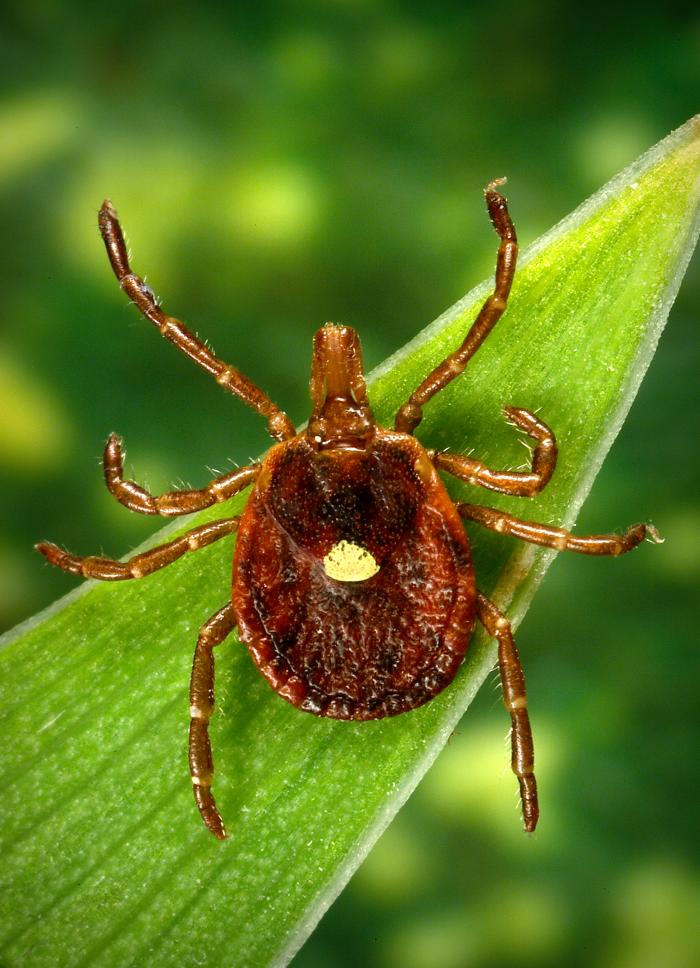
The adult female has a single pale or white spot near the centre of the scutum. Adult males have pale markings around the posterior margin rather than one central spot. Mouthparts are relatively long.

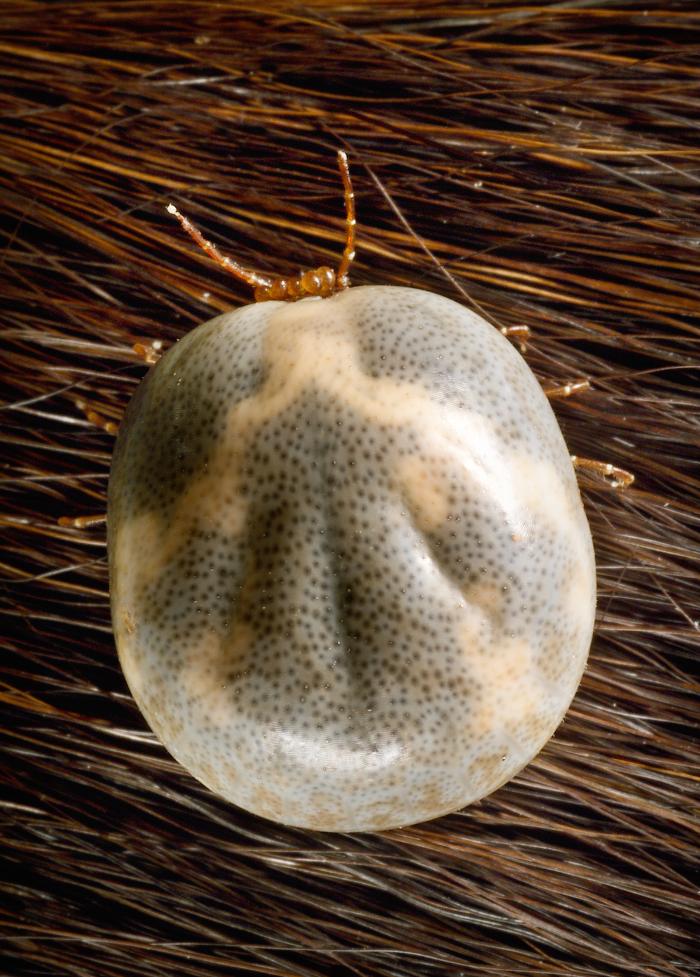
Eyes and festoons are present and the mouthparts are long. The adult female central pale spot is distinctive, but immature stages and damaged or engorged specimens require greater care.

The single central spot identifies an adult female pattern, not every life stage. Larvae may occur in large clusters and are sometimes called seed ticks, a non-specific term.

Photographs alone cannot always confirm this species. Geographic location, host and colour are supporting context, not conclusive identification; expert morphological examination may be required.

Différences sexuelles et d'apparence

Adult females show the central pale spot. Adult males lack that single spot and instead have pale ornamentation around the edge of the dorsal shield. Larvae have six legs; nymphs and adults have eight.

Cycle de vie

Three-host life cycle. Each motile stage feeds on a host and drops off before moulting or, for an adult female, laying eggs.

Étapes de la vie

  • Egg
  • Larva
  • Nymph
  • Adult

Activité saisonnière

All three motile life stages bite humans. Seasonal timing varies across the broad eastern U.S. range; local public-health information should be used.

Hôtes

  • Humans (Homo sapiens)
  • White-tailed deer (Odocoileus virginianus)
  • Small mammals
  • Birds
  • Dogs (Canis lupus familiaris)
  • Livestock

Habitats

  • Woodland
  • Woodland edges and trails
  • Grassland and shrubland

Répartition

Widely distributed in the eastern United States and more common in the South. Reported occurrence, established populations and habitat suitability are separate evidence categories.

La présence, les populations établies, la qualité de l'habitat et le risque de maladie sont des catégories de preuves distinctes.

Pays et régions

  • United States — established_widespread

    Widely distributed in the eastern United States and more common in the South. Reported occurrence, established populations and habitat suitability are separate evidence categories.

  • Colorado — rare

    Colorado State University Extension records the lone star tick as very rare, with possible occurrence in extreme eastern or southeastern Colorado.

  • Connecticut — present

    Connecticut DPH identifies the lone star tick among Connecticut ticks of public-health relevance.

  • Delaware — present

    Delaware DNREC lists the lone star tick among the five species commonly found in Delaware.

  • Florida — present

    University of Florida IFAS Extension lists the lone star tick among five hard ticks people are most likely to encounter in Florida.

  • Georgia — present

    Georgia DPH surveillance records collected lone star ticks in Georgia.

  • Illinois — present

    Illinois DPH lists the lone star tick among the ticks people are likely to encounter in Illinois.

  • Indiana — present

    Indiana Department of Health identifies the lone star tick among tick species of public-health relevance in Indiana.

  • Iowa — present

    Iowa State University Extension identifies the lone star tick among the most common ticks encountered in Iowa.

  • Kansas — present

    Kansas Department of Health and Environment identifies the lone star tick as a medically important species commonly encountered outdoors in Kansas.

  • Kentucky — present

    Kentucky Fish and Wildlife identifies the lone star tick as one of the most common tick species in Kentucky.

  • Louisiana — present

    LSU AgCenter identifies the lone star tick as one of five hard-tick species of public-health concern in Louisiana.

  • Maine — rare

    Maine CDC records lone star ticks moving north but not fully established in Maine.

  • Maryland — present

    Maryland Department of Health identifies the lone star tick among the most common ticks in Maryland.

  • Massachusetts — present

    Massachusetts DPH records lone star ticks in some places in Massachusetts.

  • Michigan — present

    Michigan DHHS records the lone star tick as occasionally found across Michigan.

  • Minnesota — rare

    Minnesota Department of Health records the lone star tick as rarely found in Minnesota.

  • Mississippi — present

    Mississippi State University Extension lists the lone star tick among five significant pest ticks occurring in Mississippi.

  • Missouri — present

    University of Missouri Extension lists the lone star tick among common ticks in Missouri.

  • Nebraska — present

    Nebraska DHHS includes the lone star tick among medically important ticks monitored in Nebraska.

  • New York — present

    New York State Department of Health identifies the lone star tick among tick species that can transmit disease in New York.

  • North Carolina — present

    North Carolina DHHS lists the lone star tick among important tick vectors in North Carolina.

  • Ohio — present

    The Ohio state-commissioned study observed lone star ticks in Ohio.

  • Pennsylvania — present

    Pennsylvania DEP frequently collects lone star ticks during statewide surveillance.

  • Rhode Island — present

    Rhode Island DEM records the lone star tick among ticks of public-health relevance in Rhode Island.

  • South Carolina — present

    South Carolina DPH lists the lone star tick among six species often encountered in South Carolina.

  • South Dakota — rare

    South Dakota State University Extension reports isolated lone star tick observations in South Dakota.

  • Tennessee — present

    Tennessee Department of Health lists the lone star tick among six key species living in Tennessee.

  • Vermont — rare

    Vermont Department of Health records lone star ticks in Vermont but does not consider the species established.

  • Virginia — present

    Virginia Department of Health records the lone star tick throughout Virginia.

  • West Virginia — present

    West Virginia OEPS includes the lone star tick in its state tick species distribution data.

  • Wisconsin — rare

    Wisconsin DHS lists the lone star tick as a less common tick that can bite people or pets in Wisconsin.

Pertinence médicale et vétérinaire

An aggressive human-biting tick and recognised vector of agents causing ehrlichiosis, tularemia, Heartland virus disease and Bourbon virus disease. STARI is associated with its bite but the cause remains unknown. Growing evidence links bites with alpha-gal syndrome; this is not the same as pathogen transmission.

Bites dogs, livestock and wildlife and can be important to veterinary health. Host and pathogen claims must remain region-specific.

Pathogènes et maladies

  • Ehrlichiosis — disease

    In the United States, lone star ticks transmit Ehrlichia chaffeensis and Ehrlichia ewingii.

  • Tularemia — disease

    A disease caused by Francisella tularensis; several tick species can act as vectors in defined regions.

  • Heartland virus disease — disease

    CDC identifies the lone star tick as the vector of Heartland virus.

  • Bourbon virus disease — disease

    A rare viral disease associated with lone star tick transmission in CDC guidance.

  • Southern tick-associated rash illness — condition

    STARI is associated with lone star tick bites; its cause remains unknown and CDC states it is not caused by Borrelia burgdorferi.

  • Alpha-gal syndrome — condition

    CDC reports growing evidence that lone star tick bites may trigger alpha-gal syndrome, while other tick species have not been ruled out.

La détection d'un agent pathogène chez une tique n'établit pas en soi que l'espèce est un vecteur confirmé.

Preuves vectorielles et pathogènes

CDC lists Ehrlichia chaffeensis, Ehrlichia ewingii, Francisella tularensis, Heartland virus and Bourbon virus among agents transmitted by lone star ticks. STARI is bite-associated with unknown cause. Alpha-gal syndrome is an allergy association, not a vector-borne infection.

Importance médicale

One of the most frequently recorded U.S. ticks on humans and an aggressive biter at larval, nymphal and adult stages.

Importance vétérinaire

Feeds on companion animals, livestock and wildlife; veterinary relevance is substantial in its established range.

Conseils pour la prévention et l'élimination

Prevent tick bites by using current public-health guidance, walking in the centre of trails where practical, using appropriate repellents, treating clothing or gear where suitable, and performing thorough tick checks after exposure.

Remove an attached tick promptly with fine-tipped tweezers or a purpose-designed tick-removal tool. Grasp close to the skin and pull upward steadily without twisting or crushing the tick. Seek professional medical or veterinary advice when symptoms or concerns arise.

Informations importantes d'identification et de santé

Informations pédagogiques et limitations

Les photographies et les caractéristiques visibles peuvent ne pas suffire pour une identification définitive.

Ces informations pédagogiques ne constituent pas un diagnostic et ne remplacent en aucun cas un avis médical ou vétérinaire.

Ces informations pédagogiques ne remplacent en aucun cas un examen ou les conseils d'un professionnel vétérinaire qualifié.

La présence, les populations établies, la qualité de l'habitat et le risque de maladie sont des catégories de preuves distinctes.