Species profile

Blacklegged tick

Ixodes scapularis
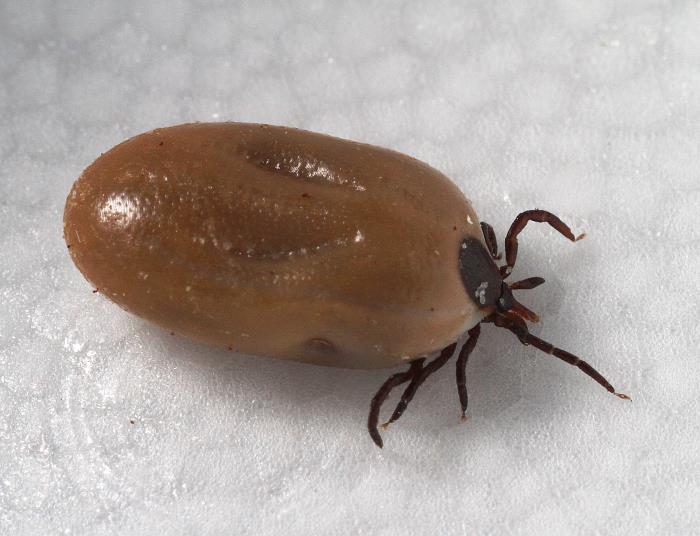
A widespread eastern United States hard tick and major human-biting vector. Nymphs and adult females are most often reported on people, although larvae also bite humans.

Engorged adult female Ixodes scapularis blacklegged tick viewed from the side
Engorged adult female

Image credit:Centers for Disease Control and Prevention Licence terms — Se abre en una ventana nueva.Source — Se abre en una ventana nueva.

Also known as: Deer tick, Bear tick

Image gallery

Quick facts

Family: Ixodidae. Genus: Ixodes. Hard tick. Taxonomic authority: Say, 1821. Life stages: egg, larva, nymph and adult. CDC describes a two-to-three-year life cycle.

Identification

Adult females typically have a dark scutum and legs contrasting with an orange-red posterior body when unfed. Adult males appear more uniformly dark because the scutum covers most of the dorsum. Ixodes ticks lack eyes and festoons and have the anal groove anterior to the anus.

Long mouthparts; no eyes or festoons; anal groove anterior to the anus. The adult female has a dark anterior scutum with a reddish-orange posterior body when unfed. Engorgement changes colour and proportions substantially.

May be confused with other Ixodes species, particularly Ixodes pacificus in western North America. Distribution is useful context but is not a diagnostic character.

Photographs alone cannot always confirm this species. Geographic location, host and colour are supporting context, not conclusive identification; expert morphological examination may be required.

Sex and appearance differences

Adult females have a small anterior scutum and expandable posterior body. Adult males are smaller and the scutum covers almost the entire dorsal surface. The accepted pilot image shows an engorged adult female, not the unfed diagnostic appearance.

Life cycle

Three-host hard-tick life cycle, commonly completed over two to three years. Larvae and nymphs take one blood meal before moulting. Adult females feed, drop from the host, lay one egg mass and die.

Life stages

  • Egg
  • Larva
  • Nymph
  • Adult

Seasonal activity

Greatest bite risk occurs in spring, summer and fall. Adults may seek hosts during winter when temperatures are above freezing. Timing varies by region and year.

Hosts

  • Humans (Homo sapiens)
  • White-tailed deer (Odocoileus virginianus)
  • Small mammals
  • Birds
  • Lizards

Habitats

  • Woodland
  • Woodland edges and trails

Distribution

Widely distributed across the eastern United States. CDC surveillance distinguishes established counties, reported records and projected suitable habitat; absence of an established designation does not prove absence.

Presence, established populations, habitat suitability and disease risk are distinct evidence categories.

Countries and regions

  • United States — established_widespread

    Widely distributed across the eastern United States. CDC surveillance distinguishes established counties, reported records and projected suitable habitat; absence of an established designation does not prove absence.

  • Connecticut — present

    Connecticut DPH identifies the blacklegged tick as a Connecticut tick associated with several locally monitored tickborne diseases.

  • Delaware — present

    Delaware DNREC lists the deer or blacklegged tick among the five species commonly found in Delaware.

  • Florida — present

    University of Florida IFAS Extension lists the blacklegged tick among five hard ticks people are most likely to encounter in Florida.

  • Georgia — present

    Georgia DPH surveillance records collected blacklegged ticks in Georgia.

  • Illinois — present

    Illinois DPH lists the blacklegged tick among the ticks people are likely to encounter in Illinois.

  • Indiana — present

    Indiana Department of Health identifies the blacklegged tick among tick species of public-health relevance in Indiana.

  • Kansas — present

    Kansas Department of Health and Environment identifies the blacklegged tick as a medically important species commonly encountered outdoors in Kansas.

  • Kentucky — present

    Kentucky Fish and Wildlife identifies the blacklegged tick as one of the most common tick species in Kentucky.

  • Louisiana — present

    LSU AgCenter identifies the blacklegged tick as one of five hard-tick species of public-health concern in Louisiana.

  • Maine — present

    Maine CDC identifies the blacklegged or deer tick among the most common ticks seen in Maine.

  • Maryland — present

    Maryland Department of Health identifies the blacklegged tick among the most common ticks in Maryland.

  • Massachusetts — present

    Massachusetts DPH states that blacklegged ticks are found throughout Massachusetts.

  • Michigan — present

    Michigan DHHS identifies the blacklegged tick as an emerging tick in Michigan.

  • Minnesota — present

    Minnesota Department of Health identifies the blacklegged tick among the types people may encounter in Minnesota.

  • Mississippi — present

    Mississippi State University Extension lists the blacklegged or deer tick among five significant pest ticks occurring in Mississippi.

  • Missouri — present

    University of Missouri Extension lists the blacklegged tick among common ticks in Missouri.

  • New Hampshire — present

    The New Hampshire government source identifies the blacklegged tick as the state's second most common species.

  • New York — present

    New York State Department of Health identifies the blacklegged tick among tick species that can transmit disease in New York.

  • North Carolina — present

    North Carolina DHHS lists the blacklegged tick among important tick vectors in North Carolina.

  • Ohio — present

    The Ohio state-commissioned study observed blacklegged ticks in Ohio.

  • Oklahoma — present

    Oklahoma State Department of Health identifies the blacklegged or deer tick in its state Lyme disease guidance.

  • Pennsylvania — present

    Pennsylvania DEP conducts statewide surveillance of blacklegged ticks.

  • Rhode Island — present

    Rhode Island DEM identifies the blacklegged tick as present and transmitting tickborne illnesses in Rhode Island.

  • South Carolina — present

    South Carolina DPH lists the blacklegged tick among six species often encountered in South Carolina.

  • South Dakota — present

    South Dakota State University Extension identifies the blacklegged tick among common ticks in South Dakota.

  • Tennessee — present

    Tennessee Department of Health lists the blacklegged tick among six key species living in Tennessee.

  • Vermont — present

    Vermont Department of Health records the blacklegged tick throughout Vermont.

  • Virginia — present

    Virginia Department of Health records the blacklegged tick in Virginia's coastal piedmont and mountain regions.

  • West Virginia — present

    West Virginia OEPS includes the blacklegged tick in its state tick species distribution data.

  • Wisconsin — present

    Wisconsin DHS lists the blacklegged tick among three tick types that can spread disease to people in Wisconsin.

  • Canada — present

    The Public Health Agency of Canada identifies the blacklegged tick among tick species found in Canada.

  • Alberta — rare

    Government of Alberta surveillance records blacklegged ticks submitted in Alberta, while noting that an established reproducing population has not been found.

  • Manitoba — present

    Government of Manitoba identifies the blacklegged tick as established in Manitoba.

  • New Brunswick — present

    Government of New Brunswick identifies the blacklegged tick in New Brunswick.

  • Newfoundland and Labrador — rare

    Government of Newfoundland and Labrador reports blacklegged ticks detected in the province, while noting low numbers and uncertainty about permanent populations.

  • Nova Scotia — present

    Government of Nova Scotia states that blacklegged ticks occur throughout Nova Scotia.

  • Ontario — present

    Government of Ontario identifies established blacklegged tick populations and risk areas in Ontario.

  • Prince Edward Island — present

    Government of Prince Edward Island identifies the blacklegged tick among ticks found on PEI.

  • Quebec — present

    Government of Quebec identifies established blacklegged tick populations in parts of Quebec.

  • Saskatchewan — rare

    Government of Saskatchewan reports blacklegged ticks in very low numbers in the province.

Medical and veterinary relevance

A frequent human-biting tick and confirmed U.S. vector of multiple pathogens, including agents of Lyme disease, anaplasmosis, babesiosis, hard tick relapsing fever and Powassan virus disease. Vector presence does not by itself determine individual disease risk.

Feeds on wildlife, companion animals and other mammals. Veterinary relevance varies by host, pathogen and region.

Pathogens and diseases

  • Lyme borreliosis — disease

    Ixodes ricinus is the principal UK vector of Borrelia burgdorferi sensu lato. Vector status and individual infection risk are separate questions.

  • Anaplasmosis and tick-borne fever — disease

    Association and vector relevance depend on pathogen strain, host and geography.

  • Babesiosis — disease

    Species, host and geographic context are required when describing Babesia associations.

  • Powassan virus disease — disease

    A rare tickborne viral disease. Vector, pathogen detection and individual risk must be interpreted separately.

  • Hard tick relapsing fever — disease

    A relapsing fever illness associated in the United States with Borrelia miyamotoi and Ixodes vectors.

Detection of a pathogen in a tick does not by itself establish that the species is a confirmed vector.

Vector and pathogen evidence

Confirmed U.S. vector of Borrelia burgdorferi and Borrelia mayonii, Anaplasma phagocytophilum, Babesia microti, Borrelia miyamotoi, Ehrlichia muris eauclairensis and Powassan virus lineage II according to CDC. Each pathogen association remains geographically contextual.

Medical importance

The most frequently recorded tick from humans in the cited national encounter review. Nymphs and adult females are most often reported on people. This profile does not estimate infection probability after an individual bite.

Veterinary importance

Feeds on domestic animals and wildlife; veterinary significance depends on host species, pathogen and region.

Prevention and removal guidance

Prevent tick bites by using current public-health guidance, walking in the centre of trails where practical, using appropriate repellents, treating clothing or gear where suitable, and performing thorough tick checks after exposure.

Remove an attached tick promptly with fine-tipped tweezers or a purpose-designed tick-removal tool. Grasp close to the skin and pull upward steadily without twisting or crushing the tick. Seek professional medical or veterinary advice when symptoms or concerns arise.

Important identification and health information

Educational information and limitations

Photographs and visible features may be insufficient for definitive identification.

This educational information is not a diagnosis or a substitute for medical or veterinary advice.

This educational information does not replace examination or advice from a qualified veterinary professional.

Presence, established populations, habitat suitability and disease risk are distinct evidence categories.