Species profile

Moubata tick

Ornithodoros moubata
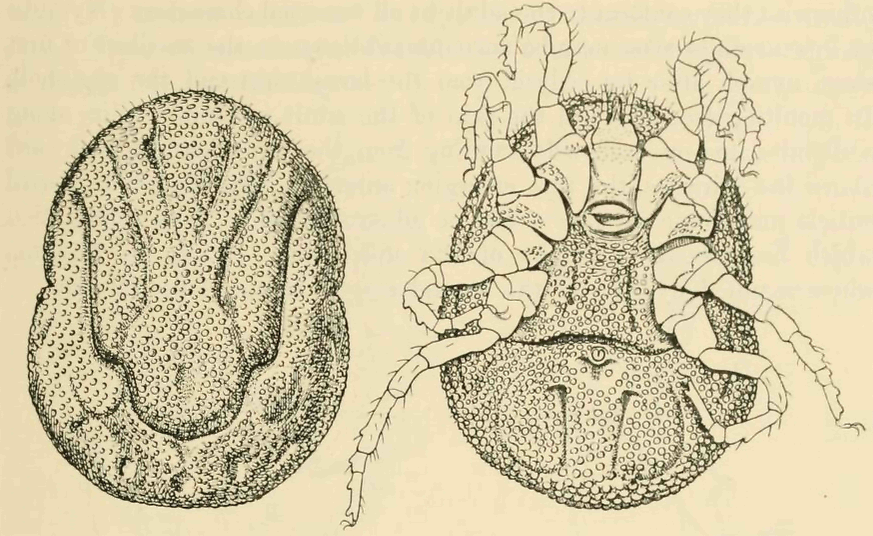
A soft tick associated with sheltered resting sites. Definitive identification generally requires specialist examination.

Historical scientific plate showing an adult female Ornithodoros moubata soft tick
Adult female historical plate

Image credit:George Nuttall / Wikimedia Commons / Nuttall et al. 1908 Licence terms — Öppnas i ett nytt fönster.Source — Öppnas i ett nytt fönster.

Image gallery

Quick facts

Family: Argasidae. Genus: Ornithodoros. Soft tick.

Identification

A soft tick in the genus Ornithodoros. Species confirmation generally requires specialist morphological examination.

Similar species can overlap in appearance. Confirm using authoritative keys and expert examination when identification affects health, veterinary care or surveillance.

Photographs alone cannot always confirm this species. Geographic location and host are supporting context, not conclusive identification.

Sex and appearance differences

External sexual differences may be subtle; expert examination may be required.

Life cycle

Soft-tick life cycle with egg, larva, one or more nymphal instars and adult stages; feeding behaviour varies by species.

Life stages

  • Egg
  • Larva
  • Nymph
  • Adult

Seasonal activity

Seasonal activity is not generalised without accepted location-specific evidence.

Habitats

  • Caves and animal burrows

Distribution

Detailed distribution is shown only when supported by governed country or region occurrence records.

Presence, established populations, habitat suitability and disease risk are distinct evidence categories.

Medical and veterinary relevance

A soft tick associated with sheltered resting sites. Definitive identification generally requires specialist examination.

Veterinary relevance remains under structured review.

Vector and pathogen evidence

Vector status is stated only where the cited source distinguishes confirmed transmission from detection, laboratory competence or possible association.

Medical importance

Veterinary importance

Veterinary importance remains under structured review.

Prevention and removal guidance

Use current public-health and veterinary guidance, avoid known tick habitats where practical, use suitable repellents or protective clothing, and check people and animals after exposure.

Remove attached ticks promptly using fine-tipped tweezers or an appropriate tick-removal tool. Seek medical or veterinary advice when symptoms or concerns arise.

Important identification and health information

Educational information and limitations

Photographs and visible features may be insufficient for definitive identification.

This educational information is not a diagnosis or a substitute for medical or veterinary advice.

This educational information does not replace examination or advice from a qualified veterinary professional.

Presence, established populations, habitat suitability and disease risk are distinct evidence categories.