Species profile

Western blacklegged tick

Ixodes pacificus
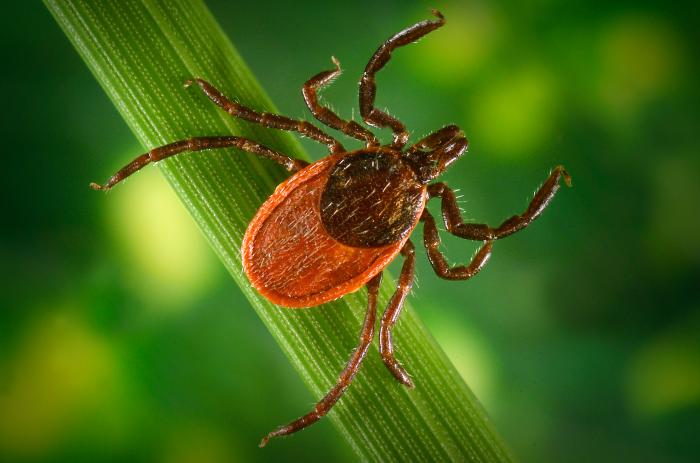
A Pacific coast hard tick, particularly important in northern California. Nymphs and adult females are more often reported on people, although larvae also bite humans.

Also known as: Western black-legged tick

Image gallery

Quick facts

Family: Ixodidae. Genus: Ixodes. Hard tick. Taxonomic authority: Cooley and Kohls, 1943. Life stages: egg, larva, nymph and adult.

Identification

Adult females have a dark anterior scutum and reddish-orange posterior body when unfed. Ixodes ticks lack eyes and festoons and have an anal groove anterior to the anus. Expert examination may be needed to separate related Ixodes.

Long mouthparts; no eyes or festoons; anal groove anterior to the anus. Adult females have a dark scutum and reddish posterior body. Engorgement substantially changes appearance.

Closely resembles Ixodes scapularis. Pacific coast occurrence is useful context but is not sufficient for species confirmation.

Photographs alone cannot always confirm this species. Geographic location, host and colour are supporting context, not conclusive identification; expert morphological examination may be required.

Sex and appearance differences

Adult females have a small anterior scutum and expandable posterior body; adult males are smaller and more uniformly dark because the scutum covers most of the dorsum.

Life cycle

Three-host hard-tick life cycle. Larvae and nymphs often feed on lizards, birds and rodents; adults more commonly feed on deer and other large mammals.

Life stages

  • Egg
  • Larva
  • Nymph
  • Adult

Seasonal activity

Human encounter timing varies across the Pacific coast range. CDC reports nymphs and adult females more often on people; use current regional surveillance for seasonal interpretation.

Hosts

  • Humans (Homo sapiens)
  • White-tailed deer (Odocoileus virginianus)
  • Small mammals
  • Birds
  • Lizards

Habitats

  • Pacific coastal woodland
  • Woodland edges and trails

Distribution

Found along the Pacific coast of the United States, particularly northern California. CDC maps separately show projected suitable habitat and counties meeting an established-population threshold.

Presence, established populations, habitat suitability and disease risk are distinct evidence categories.

Countries and regions

  • United States — established_regional

    Found along the Pacific coast of the United States, particularly northern California. CDC maps separately show projected suitable habitat and counties meeting an established-population threshold.

  • Oregon — present

    Oregon Health Authority identifies the western blacklegged tick as present mainly west of the Cascades.

  • Utah — rare

    Utah State University Extension records the western blacklegged tick in Utah but states encounters are very unlikely.

  • Washington — present

    Washington Department of Health records the western blacklegged tick in western Washington and along the eastern Cascade slopes.

  • Canada — present

    The Public Health Agency of Canada identifies the western blacklegged tick among tick species found in Canada.

  • British Columbia — present

    Government of British Columbia identifies the western blacklegged tick among ticks found in British Columbia.

Medical and veterinary relevance

A confirmed western U.S. vector of Borrelia burgdorferi and Anaplasma phagocytophilum. Pathogen prevalence and human disease risk vary geographically and are not equivalent to tick presence.

Feeds on wildlife and domestic animals. Veterinary significance varies with host and pathogen geography.

Pathogens and diseases

  • Lyme borreliosis — disease

    Ixodes ricinus is the principal UK vector of Borrelia burgdorferi sensu lato. Vector status and individual infection risk are separate questions.

  • Anaplasmosis and tick-borne fever — disease

    Association and vector relevance depend on pathogen strain, host and geography.

Detection of a pathogen in a tick does not by itself establish that the species is a confirmed vector.

Vector and pathogen evidence

CDC identifies Ixodes pacificus as a vector of Borrelia burgdorferi and the principal West Coast vector of Anaplasma phagocytophilum.

Medical importance

Nymphs and adult females commonly bite people within the species range. It is among the most frequently recorded human-biting U.S. tick species.

Veterinary importance

Feeds on domestic animals and wildlife; relevance varies across the Pacific coast range.

Prevention and removal guidance

Prevent tick bites by using current public-health guidance, walking in the centre of trails where practical, using appropriate repellents, treating clothing or gear where suitable, and performing thorough tick checks after exposure.

Remove an attached tick promptly with fine-tipped tweezers or a purpose-designed tick-removal tool. Grasp close to the skin and pull upward steadily without twisting or crushing the tick. Seek professional medical or veterinary advice when symptoms or concerns arise.

Important identification and health information

Educational information and limitations

Photographs and visible features may be insufficient for definitive identification.

This educational information is not a diagnosis or a substitute for medical or veterinary advice.

This educational information does not replace examination or advice from a qualified veterinary professional.

Presence, established populations, habitat suitability and disease risk are distinct evidence categories.