Species profile

Gulf Coast tick

Amblyomma maculatum
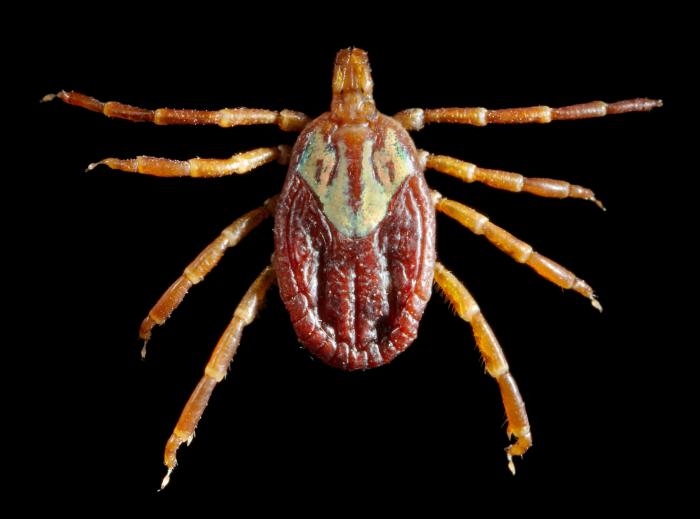
An ornate, aggressive human-biting hard tick found primarily in the southeastern United States, with focal populations reported in other regions.

Dorsal view of an adult female Amblyomma maculatum Gulf Coast tick
female · Adult · unfed

Image credit:James Gathany / CDC Licence terms — Öppnas i ett nytt fönster.Source — Öppnas i ett nytt fönster.
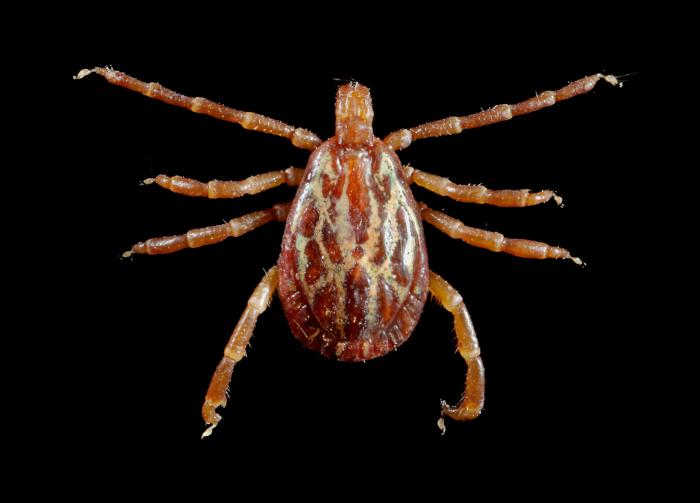
Dorsal view of an adult male Amblyomma maculatum Gulf Coast tick
male · Adult · unfed

Image credit:James Gathany / CDC Licence terms — Öppnas i ett nytt fönster.Source — Öppnas i ett nytt fönster.

Image gallery

Quick facts

Family: Ixodidae. Genus: Amblyomma. Hard tick.

Identification

Adults are ornate and have long mouthparts, eyes and festoons. Females have a patterned anterior scutum; males have pale ornamentation across most of the dorsum.

Photographs and location alone may be insufficient for confirmation; use expert morphological examination when reliable species identification is required.

Photographs alone cannot always confirm this species. Geographic location and host are supporting context, not conclusive identification.

Sex and appearance differences

Adult females have a smaller ornate scutum and expandable posterior body. Adult males have an ornate scutum covering nearly the entire dorsum.

Life cycle

Three-host hard-tick life cycle with egg, larva, nymph and adult stages.

Life stages

  • Egg
  • Larva
  • Nymph
  • Adult

Seasonal activity

Adult activity is most apparent in warmer months; timing varies by locality and year.

Hosts

  • Humans (Homo sapiens)
  • Cattle (Bos taurus)
  • Deer
  • Birds
  • Small mammals
  • Dogs (Canis lupus familiaris)

Habitats

  • Grassland and shrubland
  • Woodland edges and trails

Distribution

CDC describes primary distribution in the southeastern United States with focal northeastern, midwestern and southwestern populations.

Presence, established populations, habitat suitability and disease risk are distinct evidence categories.

Countries and regions

  • United States — established_regional

    CDC describes primary distribution in the southeastern United States with focal northeastern, midwestern and southwestern populations.

  • Texas — established_widespread

    In a Texas study of 1,625 ticks removed from people and submitted during 2014–2021, Amblyomma maculatum represented 11.9% of submitted ticks. Submission frequency reflects human–tick interactions in the study dataset, not complete statewide abundance.

  • Delaware — present

    Delaware DNREC lists the Gulf Coast tick among the five species commonly found in Delaware.

  • Florida — present

    University of Florida IFAS Extension lists the Gulf Coast tick among five hard ticks people are most likely to encounter in Florida.

  • Georgia — present

    Georgia DPH surveillance records collected Gulf Coast ticks in Georgia.

  • Indiana — present

    Indiana Department of Health identifies the Gulf Coast tick among tick species of public-health relevance in Indiana.

  • Kansas — present

    Kansas Department of Health and Environment reports that the Gulf Coast tick appears to be increasing in Kansas.

  • Louisiana — present

    LSU AgCenter identifies the Gulf Coast tick as one of five hard-tick species of public-health concern in Louisiana.

  • Mississippi — present

    Mississippi State University Extension lists the Gulf Coast tick among five significant pest ticks occurring in Mississippi.

  • Pennsylvania — present

    Pennsylvania DEP frequently collects Gulf Coast ticks during statewide surveillance.

  • South Carolina — present

    South Carolina DPH lists the Gulf Coast tick among six species often encountered in South Carolina.

  • Tennessee — present

    Tennessee Department of Health lists the Gulf Coast tick among six key species living in Tennessee.

  • Virginia — present

    Virginia Department of Health records the Gulf Coast tick primarily along Virginia's coastline.

  • West Virginia — present

    West Virginia OEPS includes the Gulf Coast tick in its state tick species distribution data.

Medical and veterinary relevance

Aggressively bites humans. Rickettsia parkeri rickettsiosis is a confirmed vector-borne association.

Adults feed on cattle, deer and other large mammals; infestation and pathogen relevance are region-specific.

Pathogens and diseases

  • Rickettsia parkeri rickettsiosis — disease

Detection of a pathogen in a tick does not by itself establish that the species is a confirmed vector.

Vector and pathogen evidence

Confirmed U.S. vector of Rickettsia parkeri. Detection of other organisms in field-collected ticks must not be represented as proven vector competence.

Medical importance

Veterinary importance

Prevention and removal guidance

Use current public-health and veterinary guidance, avoid known tick habitats where practical, use suitable repellents or protective clothing, and check people and animals after exposure.

Remove attached ticks promptly using fine-tipped tweezers or an appropriate tick-removal tool. Seek medical or veterinary advice when symptoms or concerns arise.

Important identification and health information

Educational information and limitations

Photographs and visible features may be insufficient for definitive identification.

This educational information is not a diagnosis or a substitute for medical or veterinary advice.

This educational information does not replace examination or advice from a qualified veterinary professional.

Presence, established populations, habitat suitability and disease risk are distinct evidence categories.