Species profile

Red sheep tick

Haemaphysalis punctata
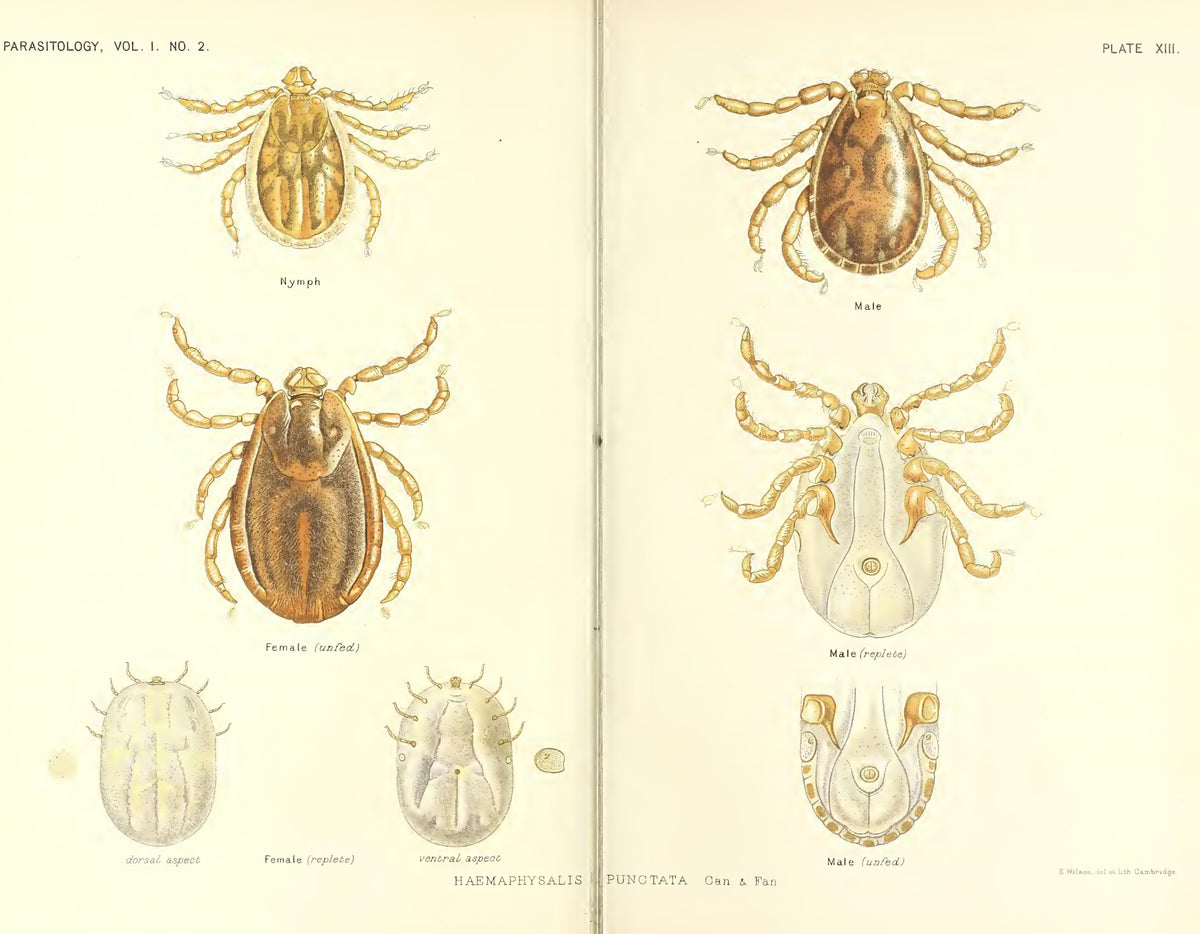
A comparatively rare UK hard tick associated with grazing habitats. Adults feed mainly on livestock, while immature stages frequently use birds and small mammals; humans can also be bitten.

Historical scientific plate of Haemaphysalis punctata showing nymph, adult female and adult male in dorsal and ventral views
Historical plate: nymph, female and male

Image credit:Edwin Wilson; public domain Licence terms — Otwiera się w nowym oknie.Changes: Resized proportionally from 5556 × 4324 px to 4941 × 3845 px for Shopify compatibility; no crop or content alteration.Source — Otwiera się w nowym oknie.

Image gallery

Quick facts

Family: Ixodidae. Genus: Haemaphysalis. Tick type: hard tick.

Taxonomic authority: Canestrini and Fanzago, 1878.

Recorded life-cycle stages: egg, larva, nymph, adult.

Identification

Identification should use an authoritative key and microscopic characters; colour and photographs alone are insufficient.

Identification should use an authoritative key and microscopic characters; colour and photographs alone are insufficient.

Photographs alone cannot always confirm a tick species.

Life cycle

three_host

Two to three years reported by ESCCAP UK & Ireland.

Seasonal activity

Spring and autumn activity is reported; UKHSA performs active surveillance each May in known endemic areas.

Distribution

Concentrated particularly in south-east England, with records in south Wales and newly detected potential activity sites. Presence is not continuous across these regions.

Presence, established populations, habitat suitability and disease risk are distinct evidence categories.

Countries and regions

  • United Kingdom — present

    Included in the UKHSA tick species profiles for the United Kingdom.

Medical and veterinary relevance

Human-biting evidence status: occasional human biter.

Borrelia miyamotoi: infection detected in a small number of uk ticks; vector competence and clinical risk not asserted.

Theileria luwenshuni: detected or associated in uk review; competence requires source-level assessment.

Babesia motasi: detected or associated in uk review; competence requires source-level assessment.

Babesia major: detected or associated in uk review; competence requires source-level assessment.

Theileria orientalis: detected or associated in uk review; competence requires source-level assessment.

Associated with livestock disease and production impacts; UK evidence and pathogen-specific vector competence require separate review.

Veterinary relevance status: high in endemic livestock areas.

Vector and pathogen evidence

Borrelia miyamotoi

infection detected in a small number of uk ticks; vector competence and clinical risk not asserted

Theileria luwenshuni

detected_or_associated_in_uk_review; competence requires source-level assessment

Babesia motasi

detected_or_associated_in_uk_review; competence requires source-level assessment

Babesia major

detected_or_associated_in_uk_review; competence requires source-level assessment

Theileria orientalis

detected_or_associated_in_uk_review; competence requires source-level assessment

Medical importance

occasional_human_biter

Borrelia miyamotoi

infection detected in a small number of uk ticks; vector competence and clinical risk not asserted

Theileria luwenshuni

detected_or_associated_in_uk_review; competence requires source-level assessment

Babesia motasi

detected_or_associated_in_uk_review; competence requires source-level assessment

Babesia major

detected_or_associated_in_uk_review; competence requires source-level assessment

Theileria orientalis

detected_or_associated_in_uk_review; competence requires source-level assessment

Veterinary importance

high_in_endemic_livestock_areas

Associated with livestock disease and production impacts; UK evidence and pathogen-specific vector competence require separate review.

Borrelia miyamotoi

infection detected in a small number of uk ticks; vector competence and clinical risk not asserted

Theileria luwenshuni

detected_or_associated_in_uk_review; competence requires source-level assessment

Babesia motasi

detected_or_associated_in_uk_review; competence requires source-level assessment

Babesia major

detected_or_associated_in_uk_review; competence requires source-level assessment

Theileria orientalis

detected_or_associated_in_uk_review; competence requires source-level assessment

Important identification and health information

Educational information and limitations

Photographs and visible features may be insufficient for definitive identification.

This educational information is not a diagnosis or a substitute for medical or veterinary advice.

This educational information does not replace examination or advice from a qualified veterinary professional.

Presence, established populations, habitat suitability and disease risk are distinct evidence categories.